Pages

Showing posts with label CPT Aboriginal Justice. Show all posts

Sunday, September 14, 2014

Living (and visiting).in Parkdale (Toronto, Ontario)-a good place to live?


A sign in Parkdale, Toronto
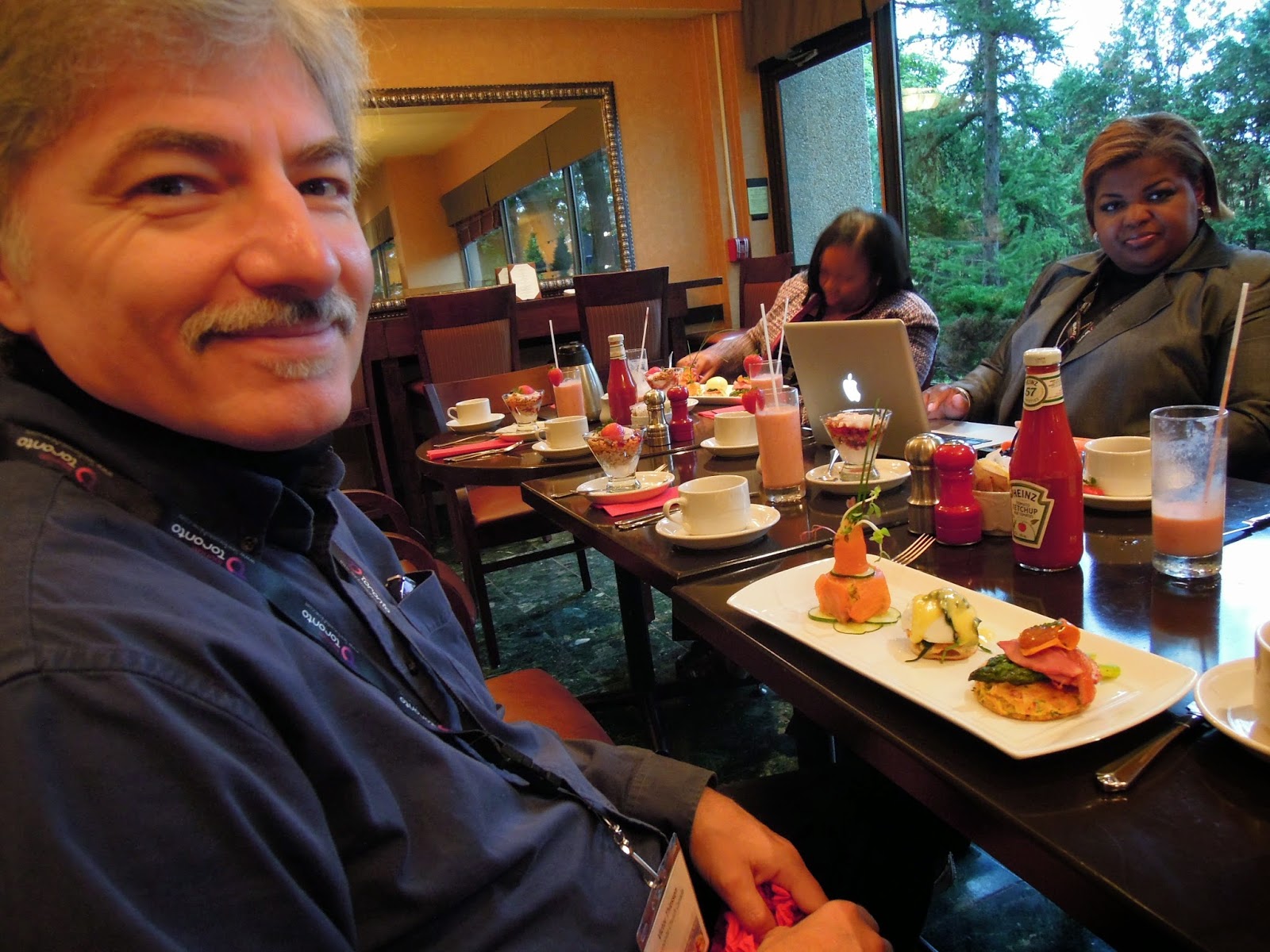
This summer I have spent some time  in Toronto on three occasions. One of the times  happened just this weekend. I had the chance to accompany my husband on a trip during which Toronto Tourism wooed church groups to schedule their large assemblies in Toronto (specifically the area near the airport). For these three days I experienced a lifestyle that is quite foreign to me, that of the more wealthy sector of society.


Breakfast Entre.

On Saturday morning I was eating breakfast with the group when one man asked if I visited Toronto very frequently. I said that I had just been here two weeks earlier, in a very different capacity. I told him that I had been staying in Parkdale. He proceeded to tell me that Parkdale was changing from a "bad" place to a very nice place to live. Young couples and students were buying houses and condominiums and making it a "good" place to be.

I sat there listening and feeling sad for the Parkdale that I had experienced just two weeks earlier. Now, maybe my perspective is a little skewed. I walked the streets during daylight hours and I did not see any evidence of some of the less pleasant aspects. But the Parkdale that I saw appealed to me- the life and activity and society of a place to live that is a huge mixture of all kinds of people.


On the other two visits  I stayed in the Christian Peacemaker Teams Aboriginal Justice Team's home in the area of Parkdale, west of downtown Toronto, and  that is quite close to Lake Ontario. The large house that my three colleagues plus two housemates live in is an old lovely duplex that was formerly the Catholic Worker house of hospitality. I have heard stories from my colleagues of visitors:  a homeless couple who lived on the porch for a period of time last summer, of racoons and little kittens or  the lonely CPT guests who drop in for a time to be with fellows of like mind . Some of these visitors have been rehoused quite quickly, others were invited to stay for a while until they were able to find suitable housing. Others made their way back to lives in other parts of Canada or the world.

This is a tiny taste of the Parkdale I experienced.. On my walks I saw a mixture of all kinds of ethnicities and cultures and ages and genders. I saw children spending out-of-school hours playing footfall/soccer together on the schoolyard, women in traditional Tibetan dresses carrying groceries home, and community gardens thriving beside a weekly vegetable market.
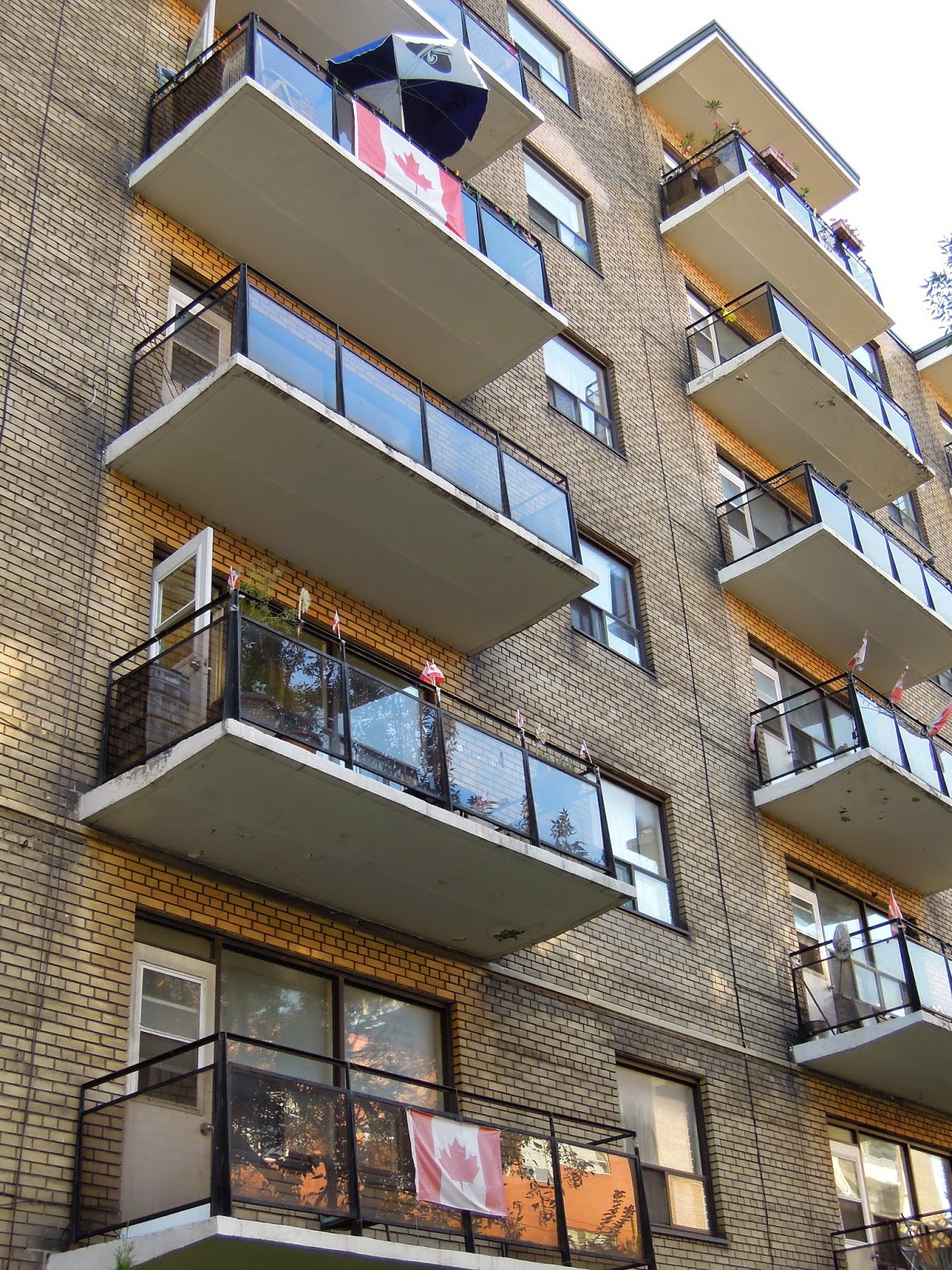
I don't know who lives in these apartments. But I did see of lot of Canadian flags- people making a new life in this country.

However, I witnessed one interaction that exemplified the village that Parkdale is, in the midst of a huge city. As I waited to cross Queen Street I spied an elderfy man walking slowly along the sidewalk. Another man met him and asked if he was going home. The first man mumbled, "yes, yes, going home".

"Then you have to turn around. Your home is that way". And the second man pointed in the opposite direction. "And (woman's name) is hunting for you. You need to go find her." He then turned the man around and sent him back up the sidewalk.

The second man then came to wait for the walk signal alongside me. I smiled at him. He said, "It sucks to have Alzheimers."

This is a place to live where every day you walk alongside new and old immigrants to Canada, old and young people, broken and not-so-broken people. I pray that this part of Toronto will not change too quickly to be a "good" place to live. Because, in my opinion, it is already a GOOD place to live.

Thursday, October 31, 2013

Settler searching for the sacred fire

The Facebook call went out- “Solidarity with Elsipogtog ; we will light a sacred fire at 5 pm at the Forks:”

 I gathered my belongings into the plastic milk crate on my trusty one-speed 1960’s bike and headed over the lovely new bike bridge crossing the Red River to the Forks.

  I reached Oodena Circle- a gathering place for many, many centuries, the place of sacred fires at The Forks. No one was there. I watched the people coming down the paths, wondering which of them would be the first to gather. No one came until one indigenous man strode out of his car to peer into the circle. I asked if he was looking for the sacred fire. He replied, ‘yes, but there is a blockade at Portage and Main. There are cops all over the place.” Then I noticed the police helicopter circling above the area.


 Oodena Celebration Circle at the Forks (photo by tripwow.tripadvisor.com )

Part of me thought I should get on my trusty one-speed and head home. The other part remembered my Christian Peacemaker Team training - I wanted to be present, to stand in solidarity with the M’ikmaq people, the Acadian people and the Anglophone people of New Brunswick. This morning they had experienced a violent crackdown on their right to protest. If this was to happen today in Winnipeg, I needed to be a witness. [My CPT colleagues who were in New Brunswick wrote this account of 17 October-here]


On my way to Portage Avenue  and Main Street I passed streams of cars and trucks diverted to roads not usually travelled. The traffic cop helped me to cross the street. I could not hear it but I imagined the grumbling and swearing inside the vehicles, the drivers forgetting that each vehicle burned a sacred substance - the bones and muscles of millions of animals buried deep within the earth and then pumped out to fuel our desire for oil. This was not the sacred fire I searched for.

 As I found the east end of Portage Avenue that was totally empty of cars or people I heard the drumming. I came up to the intersection where no human usually dares to walk and saw a round dance. Police had blocked off all four roads with their cars. A few bikes were laid on the boulevard. I wasn’t sure what to do with my trusty one-speed so I walked with it closer to the circle, my bike helmet on and my face red with exertion.


 I watched and listened. There was a woman sitting in the very center of Portage and Main celebrating an individual pipe ceremony. There was another tiny fire five steps away from her. I thought they were connected - one fueling the other. Later I heard that the fire was the remnants of a burning Canadian flag. This was what the media reports focused on. There was no recognition of why an indigenous person might want to do such an action and no acknowledgement of the deep meaning of the pipe.


As I stood I heard a drum beat come closer and closer to my right ear. I looked and saw one of the women drummers standing right next to me. We looked at each other and she stopped drumming for a minute, taking a beautiful new handbag off her shoulder. It was sewn in the four colours [representing the four colours of all peoples: red, white, black and yellow]. She handed it to me, we looked at each other for another few seconds and she moved on, picking up the beat again.
 

 I stood in silence again. I had ridden downtown to find a sacred fire. There were no flames rising from the heart of Winnipeg’s biggest intersection, and I hadn’t expected to find any there, but as I thought about it, I knew I had found the sacred fire. Within each of the people standing and drumming and dancing and singing, there were billions of cells. Within each cell were the mitochondria. And within the tiny mitochondria there was the burning of the fuel of food eaten to create energy- the energy for life process such as movement and growth and activism and solidarity.

 This settler of Irish and English ancestry found the sacred fire at Portage and Main in Winnipeg, Manitoba on 17 October, 2013.