Pages

Showing posts with label CPT Iraqi Kurdistan. Show all posts

Sunday, February 14, 2016

Changing the small things-Iraqi Kurdistan CPT training

Thursday, January 28, 2016 at 6 pm was the long awaited minute. The CPT Iraqi Kurdistan team had scurried all over the city of Sulaimani buying flip-chart paper here and toilet paper there. We needed extra supplies of kerosene and two rechargeable lanterns for the inevitable electricity cuts. We found all the handouts on our computer, had them printed and bought red binders to hold them.

The moment arrived and supper was hot. They began to enter the CPT house-the eager, excited, laughing new CPT trainees.

I stood in the doorway to our team's kitchen looking on the scene. The new lantern was put to immediate use, so the florescent glow lit the faces and the steam from the food. I felt joy and anticipation fill my chest. We were beginning the journey.

About half of the trainees are also working or studying full time so our schedule is  different than a usual training in Chicago. Instead of spending 30 days together, they all come on Thursday evening for supper and then spend over 3 hours, late into the night, intent on learning the material. Then bright and early on Friday morning- the usual day off- they are ready to begin again. By 930 pm many of them go home and the week begins again.

In mid March the region has the Spring holidays for Nawroz. The trainees will then come every day -early until late- so that all the material can be covered before early April


This  training is unique to any I have attended or facilitated in the six years since I joined CPT. There are ten trainees: one from Poland, one from Colombia and eight from Kurdistan-Iraq and Syria. It is a multi-faith group: Christian, Muslim, seeking and those that have a deep spirituality but who do not identify with a specific organised faith.


We facilitate the sessions in English with space for those more fluent  to explain a concept in Kurdish. Then while we are on break time, Kurdish is the dominate language, with explanations in English for those of us not as proficient as we should be.


Most of the trainee's lives have been directly impacted by the violence in the region. We heard several times on the first day indications of this. One person asked permission to keep his phone on with the tone turned off. His father was heading to the front line and he needed to aware of when that would happen. Others spoke of people they have lost due to separation or death due to the war that is happening throughout their countries.

Our first role play where they simulated walking alongside  farmers 
in Hebron who were harvesting olives.

One of our first spontaneous activities was to attend a vigil to remember and grieve for the 58 people including 25 Iraqi Kurds who drowned in the Aegean Sea last week. These are the things we had to process on our second day of training.


I sit in the room with these amazing people as someone who has had six years of experience with CPT. I facilitate my sessions with some knowledge of what we want them to learn or think about. Yet, I know that when I leave Iraqi Kurdistan on 17 March, I will have learned so much more from them.
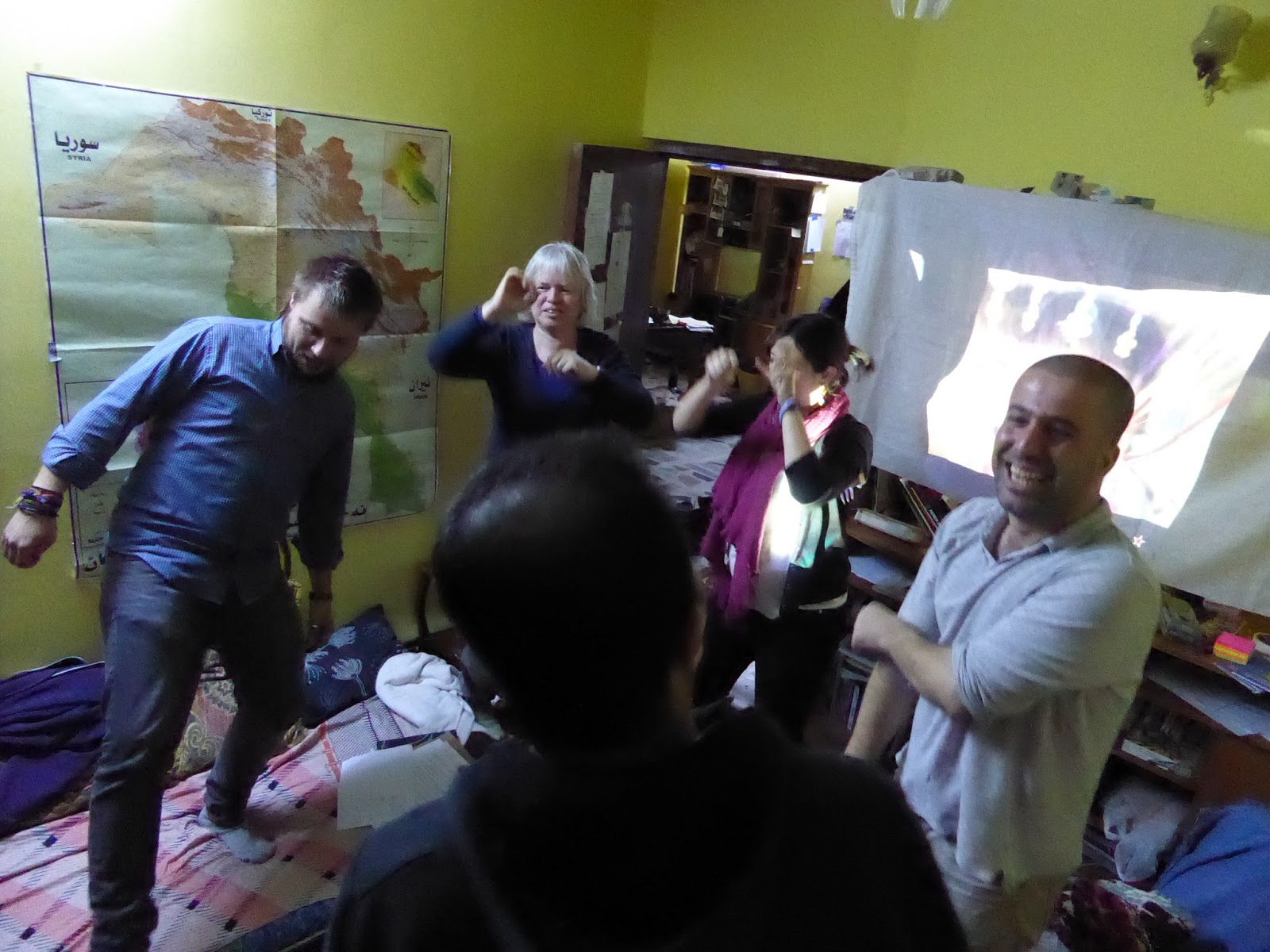

 This week we began to work on the module where they plan a public action. They  agreed to an topic that faces a small bit of the oppression that is happening in this region. The trainees had to think hard of ways to get the message across in a way that would not endanger any of them. They knew that arrest in this country can bring with it beatings and, for some of them, deportation back to a war-torn country. Yet, they also knew that it is very important to speak to the powers that are causing the oppression. The consensus came down to a simple message with a subversive undertone. This week they will continue the planning to bring about the action next Friday.

One morning,  as I ate breakfast with Jahne who is from Rojava (Syrian Kurdistan) she said, " The reason I want to be a part of CPT is that CPT works to change the small things. I can not change the war, or the government in my country but I can change the small things. That is what CPT does."

This amazing group is  on the beginning of their journey.We have already grieved and danced and discussed and agreed and disagreed. They have a lot of listening, thinking, pondering and changing to do before the CPT training graduation at the beginning of April. I know that they have dreams of transforming the big things, in this region, in these countries, in this Middle East. However, along the way, they can start on the small things.

Amen and may it be so.

Thursday, February 4, 2016

A poem" The boats, the sea, the lives"

Yesterday morning our team joined together for our gathering/worship time. The internet had turned on after the night and so people were taking a quick look at their Face Book and emails. My team mate Mohammed showed me a photo of a teenage boy and a woman. I looked at him with a question on my face. He said, "he was my student". I said, "he drowned?" Mohammed's face told me that I was correct. Yad had been in his class two years ago. The impact of the deaths drew near to us.

Lukasz immediately changed the topic for his gathering. We sat in silence and drew and wrote out our feelings. Last week 28 Kurds died in the Aegean Sea, yesterday 103 were on the boat, including young Yad from Sulaimani. I wrote this poem as we sat together. 

The boats, the sea, the lives

Kurdistan, oh Kurdistan
How I hate to leave you
But how I long to leave you.
Political crisis, financial crisis
No electricity, no salaries, no school
There is no life, there is no hope
There is no future for my son.
We must leave

I heard about thousands drowning in the sea
Surely they were not prepared
Surely they paid the wrong smuggler
Surely they bought the fake life preservers
We will do better
We will stay in the boat and live

Today the son is a photo on Facebook
Yad- his fourteenth year was his last
There is no life, there is no hope
His body will return to Kurdistan.


Monday, April 15, 2013

Come Join in the dance- Part 3- Iraqi Kurdistan

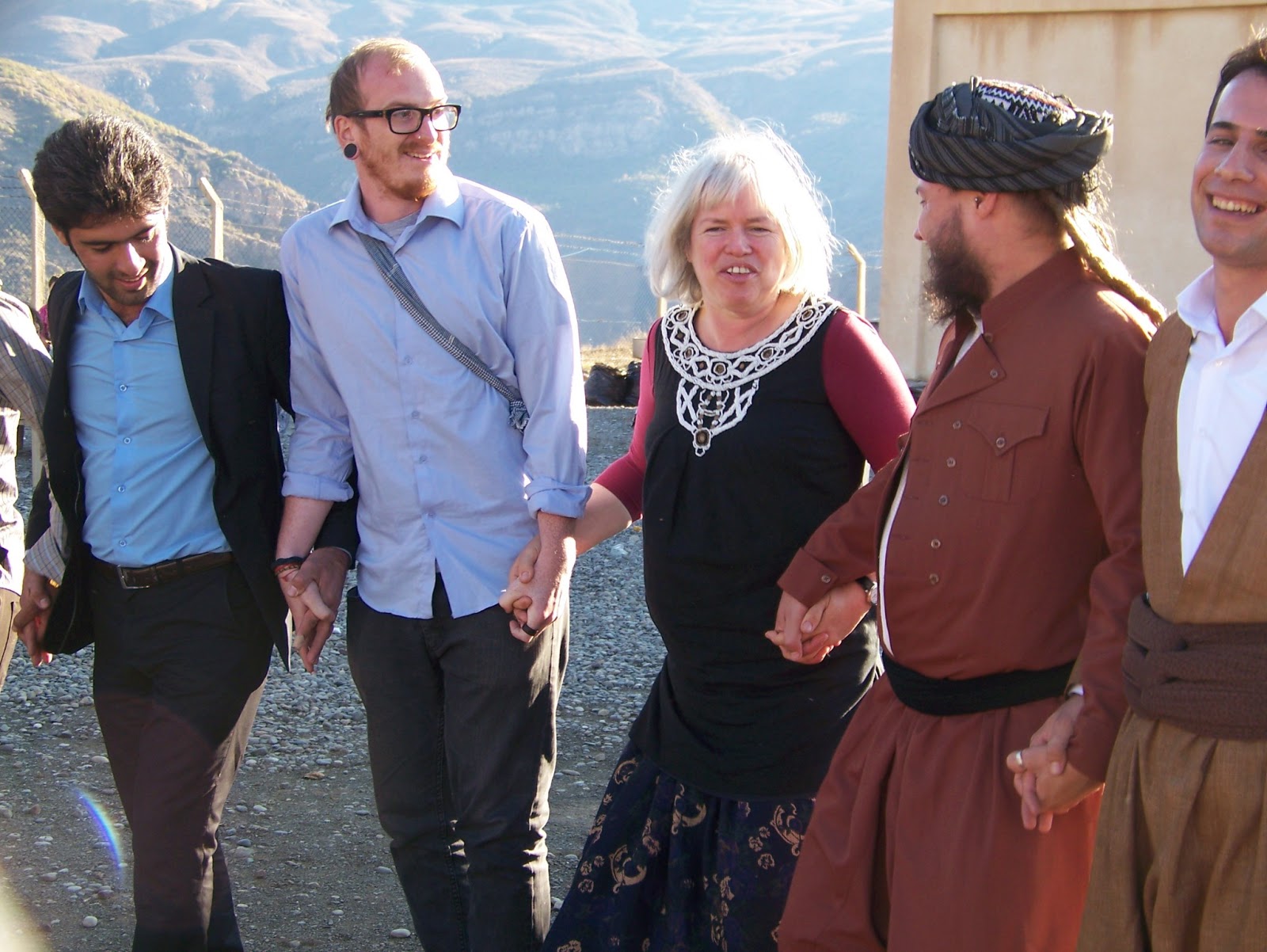
In the noon break of an Idle No More conference I joined a small round dance led by a women's drumming group. As the dancers clasped hands and formed a semi-circle, our legs moved in rhythm and our arms kept the beat. As I joined my friends in the dance I looked around and it seemed very familiar. The formation, the legs and feet, the hands clasped and the arms beating took me to the mountains of Iraqi Kurdistan. Only the music was different.

Dancing  is an integral part of the culture of the Kurds. Small groups or large groups can break into spontaneous movement- in the forest, in a meadow, on the street or even sometimes on the bus.  At the big Spring/New Year celebration, Naw Roz, family groups picnicking throughout the countryside bring loudspeakers and electronic players.These provide the beat and music. Then the  generations of friends and family  join hands in a semi circle, which can extend to a full circle if there are enough people. The feet move sideways around the circle while the arms and shoulders move vigorously to the beat. Occasionally, one has the privilege of having a live group playing drums and cuzela  (a nasally oboe type of wind instrument).

 Weddings are not complete without huge speaker systems that blast singers such as  Aziz Waysi, a very popular singer, and the circles of moving shoulders and feet. Below is a great video that shows village life along with an example of his music.
Our team was invited to celebrate the wedding of a son of one of our partners. The Autumn day was still quite warm and the sky blue. The mountainous region called the "Quandil" rose high above the foothills. The wedding celebration was held outside, on the grounds of a rural football/soccer stadium. Women, including the groom's mother,  prepared food over propane fires in large vats. Then the young men served the rice, chicken, mutton and vegetables to the women and children who sat on rugs around a plastic tablecloth. The men and older boys ate  separately. However, once the mess was rolled up in the disposable tablecloths and cleared away, the loudspeakers were unloaded from a big truck. The men moved over to the area with the women. And the dancing began.


 This is a bit of footage that I took with my little Nikon. It is a little rustic but shows the beautiful "jili Kurdi" and the long sleeves tied behind the back of the women.
 
My team mate who was brought up in the Christian faith said that his experience was turned around. There men and women were able to eat together and talk together but dancing was not allowed. Here men and women  must eat and talk separately, but when it comes to dancing they are welcome to join hands and dance side by side.

My Kurdish dancing experience mirrors the welcome that I have experienced in all my interactions with Kurdish people. They seem excited and  a little amused  that we desire to join into their cultural traditions, whether that is eating Kurdish food, sleeping on mats on their floors or joining their family in dance. But they say beker bate..welcome, welcome. ["You may be a  little strange looking and you don't know how to dance very well,"] But welcome, please come and join us..


I don't have any video footage of me joining the dance, but here are a couple of still photos.(Rosemary Milazzo)

Monday, March 4, 2013

Guest post: Iraqi Kurdistan: Nonviolence 102

( Dancing part 2 and 3 are still to come, but here is a reflection by team mate Annika. The team has done 4 of these workshops so far in high schools, and plan a few more before school closes this year. It is very exciting to me as we had dreams of doing this last year. Now it has really happened with great evaluations from the students).


IRAQI KURDISTAN: Nonviolence 101
by Annika Spalde
The classroom was cold and crowded with old and squeaky benches. We began moving them aside a bit, to make room for the exercises. A group of girls came in and eagerly sat in the front benches. "Oh, there's no electricity! We can't show them the film clips that we've prepared!"
"Some of the students need to take a bus at twelve o'clock, so there's only fifty minutes for the workshop," said one of the teachers. Hmm. We had asked for an hour and a half…. More and more students come in. We had agreed on forty but I think that there were sixty or more. Okay, we say to one another, let's do the best we can under the circumstances.


After a short introduction of us and CPT, I start with the first exercise, the spectrum. "Those of you who believe that there is a lot of violence in your society, you put yourselves on this end of the line. If you think there is not a lot of violence in society, you go to the other end." They come up, and most of them go to the "a lot of violence" end. "Why did you put yourself here?" I ask the guy standing on the far end. "Yes there is a lot of violence," he responds, "for example in the homes, against women." Another says, "Some people have the possibility to go to fancy hospitals abroad if they need care, most of us can't do that." A third student says: "There is also psychological violence, like when someone speaks in a degrading way to another." They give several more examples. I'm surprised at how quickly they think of different kinds of violence, and how eager the children are to share their thoughts.
Lukasz takes over the facilitation, "So, how are we, as a society, going to move from this side to the other side of the spectrum? There are two common reactions to violence. One is to respond with violence, the other to run away, or just look the other way. Nonviolence is a third alternative. It means to fight for justice and peace without the use of violence." The students had ideas about how to do this. "We need to learn more ourselves. We need to educate people about nonviolence." Mohammed and I then shared briefly about Gandhi, the principles of nonviolence, and some nonviolent methods. In the beginning the atmosphere was kind of messy, but by now everyone was listening attentively.
Afterwards when Mohammed read aloud from the students' written evaluations, I felt happy and grateful. "It should have been longer!" one student wrote. "I have learnt that violence only gives rise to more violence," said another. "You forgot to mention sexual violence." "I want this kind of workshop every year." Maybe we have sown a few seeds, even if this time the workshop was so short and a bit chaotic.