Pages

Wednesday, December 12, 2012

Back to October- Wedding celebration

As I sit here in Bammental, Germany I am looking at the photos of my time in Iraqi, Kurdistan. I realize that I have not posted about my first Kurdish wedding. This was celebrated on the last day of Eid. in October.  CPT Iraq Kurdistan's longterm friend, M, invited us to the wedding of his son. I was reminded again how the lifestyle of the Kurdish people is so different than mine. The wedding had been planned for four days earlier. However, a relative died and that took precidence. So the date of the  wedding was changed. This would be unheard of and almost impossible in my culture where invitations go out months ahead and venues and caterers are paid for as well.

I really enjoyed the day in the foothills of the Quandil mountains, sitting on the ground eating with the women, and dancing to the best of my ability in Kurdish style. The bride and groom are not pictured in this post because due to his job he asked us not to put their pictures onto the internet.

 
Rest stop at Gali Ali Bag . Pat T, me Lukasz F. Rosemarie M.
 
 
Preparation of the meal
Young men preparing to serve the meal
The women and younger children all seated around the tablecloth on the ground. Bread is being distributed to go with the rice, beans in tomato sauce, chicken and mutton.
 
Clean up. Put all the disposable dishes and scraps of food onto the tablecloth and roll it up.

Collecting the coloured bits of paper from the poppers.
 
 All ages come to the wedding.
Old...
.. and young.
 
Patrick and Rosmarie trying their feet at dancing.
Rosemarie asks our constant taxi driver, Soran, if he wants to dance. One can do that when you are 80 years old.!
After I took some photos of some girls, they wanted to take one of me. Here I am in front of the glorious Quandil mountains.
 
Pat, Lukasz and I join the dance.


Friday, December 7, 2012

The Turkish green grocer- Pro Palestinian and Pro Kurdish

So, I can't wait to write about this encounter because it was so fun. I will go back and write a couple of more things about my time in Iraqi Kurdistan, but this just happened.

Yesterday I flew from Sulaimani to Frankfurt, Germany, then hopped on 3 trains and ended up in the small village of Bammental, where my daughter, Janelle, and her husband, Laurens, live.
 
Here is Janelle doing her duty at shovelling snow that started this morning, just in time to start acclimatizing me to winter in Canada.

Today we went shopping for some white beans and tomato paste (to make fasouli-white beans in tomato sauce) at a nearby Turkish shop. I want to make a Kurdish meal on Monday for some of their friends.  As we went to pay I asked him where he had used to live before immigrating to Germany. He said, Ankarra. So, then I took the plunge and told him that I had just come from Istanbul the day before. He made a face and commented that Istanbul was not a wonderful city. So, then I said that I had been in Iraq before Istanbul. He told me that was a very "gefahrlich/ dangerous" place. He said that the Americans had destroyed it.

Now, I am aware that speaking to a Turkish man about Kurds does present a bit of risk (Janelle told me later that I was pretty "ballsy"!). But I was watching his responses and took the chance of telling him that I had been in the northern part of Iraq where it is not as dangerous as the south. And then our conversation took an interesting turn. He told me about Syria where maybe the Kurds will have a situation like the Kurds in Iraq (autonomous region) and that he was very much in favour of the Kurds having this. He did not say it, but I felt that he would agree for the same situation in Turkey.

Then he began to speak of how America wanted to put their fingers into everything and how they supported Israel. He then went on to tell us how he thought that Israel was grabbing land from the Palestinians. He said that all conflicts were about wanting more things  then we needed.

All this conversation happened in German and I was quite thrilled that I understood most of what he was saying!! After we paid for our groceries (he thought that we should buy the cans of beans, but we convinced him that we wanted the dry ones)  he asked us to wait a minute. He went over to the shelves of pickles and picked up a very large bottle of pickled peppers, tomatoes, carrots and cauliflower. He told my daughter that he wanted to give 'madam (me)" a gift and gave me the large bottle. I felt like I was back in Kurdistan- gifted by a Turkish man.


I placed the mug next to the jar so you could see how big it is!!

Monday, December 3, 2012

Did I see what I really saw?


It was so surreal, crazy, bad, good and a day that made me heart heavy.

It started that we were invited to a demo in Zharawa which is about 2 ½ hours away. The prime minister of Iraq, Malaki, has trained and just last week put into the disputed cities, Mosul and Kirkuk, a huge armed force. These two cities are full of oil, thus, although they are in Kurdish area Iraq will not let them go. There was a referendum promised years ago that still has not happened so the cities are still in limbo with a lot of violence.

 This  is very disconcerting to the Kurds as they have  very recent memories when Sadaam brought forces into the Kurdish area and committed genocide.

 
Anyway we were asked to attend this demo. It is unique in that it was organised by a woman’s group and a teacher’s group. We said that we would go as observers.

 
Zharawa is also home to one of CPT IK’s longest friends, B. We had not visited for a long time so phoned him to say we were coming.

 So Lukasz, Garland and I drove to his house and when we got out we noticed that something was up. There was an Asaisch (security police) vehicle with many officers outside his gate. We went in and were seated. He came into the room and said that a young man and woman from Iran had fallen in love and run away to this area and were secretly married. 25 days before.  B is known in the region as a very wise man.The families came to him as mediator and they were dealing with this in the next room.

 We had been invited for lunch but when we were seated our host apologized  for the lack of food. He had been unaware that all these people were coming and they had eaten most of the food prepared for us. He then left again into the next room for more negotiations..  As we sat around the tablecloth on the floor I noticed a very old women seated by the wall. Soon B’s wife and daughter came to her and helped her to her feet. I realized then that it was a very young woman. She looked so dreadful. They walked with her into the negotiation room.  About ten minutes later B came out and told us it was decided that they would be divorced.

 
Then a switch happened when the families and young women went into another sitting room and we went into theirs for tea. The young bridegroom was in there. He spoke with us and one thing he said struck such sadness in my heart. He said, “I don’t mind not being her husband, but I hope that they don’t kill her.”

 
A while later some men came into the room to say goodbye. Our translator, A., said to us,”don’t stand up, don’t stand up”. He reminded  us later that standing is a sign of respect. He did not want us to show any respect for these men who did such a horrible thing to their children and he did not know how they would treat the young woman.

 
THIS IS WHAT I THOUGHT THE STORY WAS WHEN I RETURNED HOME.
 
That night I did not sleep well. My sleep was invaded by images of the young woman and fear for her future. I woke up and read and then wrote a poem. I came to our team worship the next morning very tired and  emotionally distraught. I found out at check-in that Lukasz and Garland were feeling similarly to me. We did not understand.
 
The next day I spoke with one of our partners who works with violence against women. He told me that this situation is common  and is one of the things that they are working to educate people against doing.
 
BUT
The next day our advisor and translator Mohammed spoke with B. He told us the story was very different than we had surmized during our visit. The young couple had married 25 days before but the woman had called her family to come to get her because she wanted out. So the negotiations were about how to deal with her desire for a divorce. This was decided on and the family took her home. B. had spoken with her and the family stated that she was doing well.
 
SO CONFUSING....
 
So, maybe my poem (below) was not for this young woman. But as our partner says, there are young people who face the wrath of their families who disagree with their choices.
 
BUT
As I thought about this I realized that similair things happen in my culture. Young women are thrown out of families when a pregnancy is discovered. Young men and women are thrown out of homes when they have the courage to tell their families that they have fallen in love with someone of the same gender.  And so on... Families in different cultures dealing with children in cruel ways.
 
November 24, 2012
The Woman With the Dark Sorrowful Eyes
I cried into my pillow last night
Thinking of the woman with the dark, sorrowful eyes.
She sat by the wall in the room where I ate normal rice and chicken
My eyes saw an old dapir/oma/grandmother
Hunched over, shawl covering all
As two other women helped her stand, one on each side
I saw that she was so, so young.
Yet buried, burdened with a load that no woman should carry.
Her load? A love, a journey, a vow to cherish and stay until death do them part.
Yet today the parting comes
Her family decrees a separation, a divorce
She shall return to the home
He shall return to the home
Never more to cling to each other
Twenty-five days- now decreed over for ever.
She carries this load and the burden of being a scar, a disgrace, an unwanted woman.
I cried into my pillow last night thinking of the woman with the dark sorrowful eyes.


Monday, November 12, 2012

Of pomegranates and juice running down the arms

Last week I spent two days in Ranya. The trip to was attend the two nights of the Cultural Festival that Pat wrote about on the previous post. But the day in between I spent with one of my favourite families in Iraqi Kurdistan. Nishtiman and Xhalid are our friends in Ranya. Nishtiman's family includes me like a daughter and sister when I visit.

On this day I told Nishtiman that I wanted to see her mother. N. told me that I could go there but she could not, as she was busy with the festival. That meant that I was on my own for language. That felt OK. I had the Kurdish in my head and my trusty dictionary, along with a lot of patience on the family's part and mine.

So, over I went. First there was a bit of confusion because they were setting down to eat breakfast and I had already eaten and could not manage another bite. Once that was settled everyone around the tablecloth on the floor seemed to decide that it would be a great idea for me to have a shower. Now, this was great news for me but I chuckled to think that this was a universal agreement. When I was done I was congratulated-'Perozbet". I did not really understand why I was been given the word that one receives on holidays, birthdays and births. But I think they liked a clean me and I did too so all was good!!

Nishtiman came home for lunch and told me before she left that the family was headiing out for a picnic with "hanar/pomegranates. I did not really undersstand what that meant. Usually picnics have coal burners with chicken on sticks and dolma. But I was game and picnics are fun.So we all piled into two cars. I was given the seat of honour beside the driver (son-in-law Asaad) while everyone else doubled up in the back seat. I tried to get the young grand daugher to share my seat, but either that is forbidden by traffic laws, or they did not want to disturb my comfort.

We drove out into the mountains. Ranya is at the foot of the Black Mountains (they look black when they are wet), but I don't know which mountains these were. We began to encounter  tiny villages and more animals and people waving at us as we passed. Occasionally the cars would slow to honk at people working in the yards and they would greet the family.


Pomegranates hanging from the trees. It sure is different than paying $1.50 for one in Canada.


The family gathers and gets ready to pick fruit
 
 
Elea fell asleep on the journey in the car, so this is her comfy bed for her nap. I think her family shared my opinion that she looked like "sleeping beauty" so they placed a bit of pomegranate by her head.


Strategies to get the fruit from the tallest trees; pulling and holding tall branches and using sticks to knock them down.
 
 
And further strategies for getting walnuts out of the tall, tall tree. This is son, Dilzar.

Mother, Gul (means flower) and son in law, Asaad.
 
 
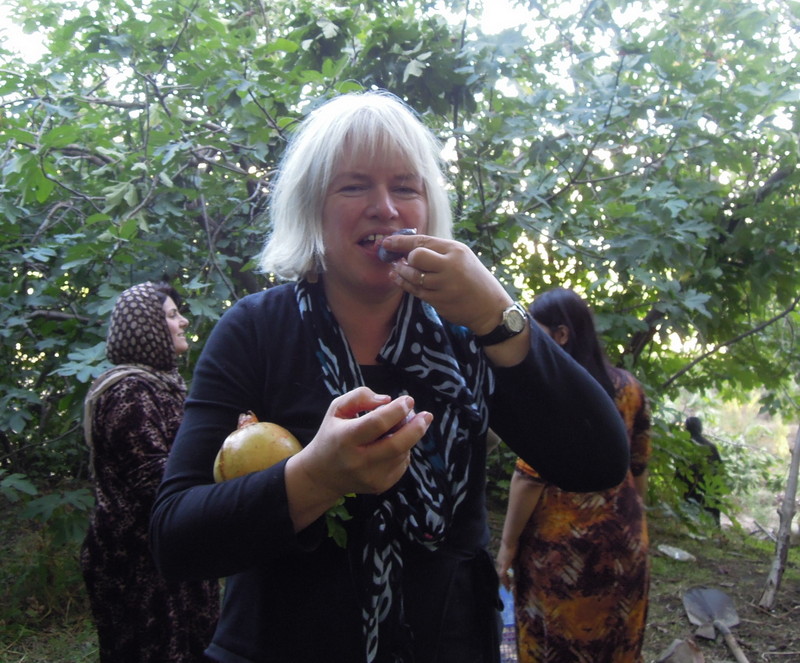
I stuffed myself full with pomegranates and beautiful ripe, purple figs.

Grandson (I think his name is Rebaz).


On the way back to the car. I am not sure what Gul was doing, but when she looked at the photo she thought that she looked like the queen.
Gul, sister to Gul's husband, Razhan (daughter in law), Sharaban (daughter), me, Ranya (grand daughter) and Rebaz (grandson)

 
 A lovely photo of the women in my car.
Pari, sister of Gul's husband, Sharaban and Ranya.
 
 Asaad, Gul's son in law and husband of Pari. He drove me around to show me the spring for the village and to see some of the tiny villages in the area. As he took my photo in this spot he said, "you know what this is?" I surprised him by saying that it was a gravestone. A  old gravestone, but it may be from the time of Sadaam's anihlation of the villages. His family left the farm with the pomogranates 20 years ago.

Wednesday, November 7, 2012

Guest post- "Late Nights in Ranya"

This post is written by my team mate, Patrick Thompson. I was there that night, although I was not awake as late as he was. (I regretted it the next morning when I heard what he had experienced).  In his description he makes me feel like I was back there in the dark in Ranya.


The chill of the night was kept at bay by the constant shuffling and stamping of feet on the soft short grass and the rhythmic shaking of our shoulders.
We were dancing, Kurdish style. The long semi circle of men and women holding hands tightly bunched, shuffled in time with the drum and oboe. Cheers, whoops and shouts exchanged between the excited dancers.
The semi circle multiplied, there was two, maybe three with individuals dancing, twirling and hopping between them.
 These dancers represented the world.
 
Kurdish, Turkish, Arabic, Assyrian, Persian. Christian, Muslim and Yazidi. Standing side-by-side, dancing, shuffling, twirling to the rhythm of the drum to the melodies of the oboe.
Politically the situation in and around Kurdistan is difficult, complex. The conflict in Syria, hunger strikes and military action by Turkey, threats of war against Iran not to mention the struggle for independent Kurdistan as a whole. The politics, fueled by money and power, racism, xenophobia and old militaristic alliances, has little to offer the common citizen any more, yet it controls everything. Business is done, the fires of war are stoked, accusations fly, and the people suffer.
But here, entranced by the music, the common bound of all people, the politics ceased to be. Relationships were built on mutual respect for each other’s gifts, talents and passion and the struggle to push their talents to the limit.
The Ranya cultural festival was a hotpot of music and dance from around the region. Two nights of bright lights and camera crews, aimed at a stage providing an opportunity for young performers to entertain more than 5000 people. They all reveled in the opportunity and didn’t disappoint.
But it was the after show party, the after hour activities that really showed the spirit, the joy and the passion of this ethnically, culturally and religiously diverse group of people. As the performers gathered to entertain themselves, they no longer performed, they played and played and played into the small hours of the morning, sharing songs of love and lost, life and death, dancing, clapping and stomping the beat, or holding back, in solemn silence, as a Mamosta (teacher) shared an unaccompanied ballad that touched the heart of every soul in the room.
Politics’ is complicated, it creates aims it fails to achieve, deadlines it fails to observe, promises never fulfilled, budgets that never match reality. All of which are an excuse used by one side against the other, who in turn act the same.
These politics stand in the way of peace. Amongst the dancers I stood shoulder to shoulder, a smile on my face and a laugh in my voice as my feet tapped in time with theirs. We danced; Kurds, Turks, Persians, Arabs and me, the British man, and there was peace.
Our people have struggled against each other for centuries, the oppressed and the oppressors, fought for money, power and control yet here, as the music played, there was peace.
In the end, it doesn’t matter who has the power, it doesn’t matter whose president or prime minister or which party has control. In the end all they want is your vote, you’re “OK”, so they can stay in control, lining their pockets, satisfying their interests. Real change, change that moulds history, never comes from the top but from the people; the musicians, the poets, the artists, the dancers, the singers, the appreciators, people of joy, passion , peace and love.
 
The beautiful hand embroidered  costume  of the Christian dancer. They are part of community who had lived near Mosul, Iraq and have moved to Dohuk, Iraqi Kurdistan for security and peace.


Sunday, October 28, 2012

Am I brave?

I have now been coming to Iraqi Kurdistan for over 1 1/2 years. So many times people have said to me-"you are so brave" or "I wish I had your courage". I don't want want to disregard these people's opinion and say '" Oh it's nothing" or "I don't really have anything to be extra brave about."  Maybe, I am brave. I know that on Sunday of the last weekend in August, 2006, something happened within my head and soul to allow me to shake off my fear of the unknown and to take the first step. That was applying for the delegation to the West Bank. I have been on a wonderful, crazy journey since then. 

But, am I courageous? Sometimes living here in Sulmaini I don't see any reason to require extra courage then I need to live in North Kildonan, Winnipeg. But then again as I expereinced live gunfire in the end of the demonstrations in April 2011, I certainly felt that any courage I had leaked out extremely quickly, turning me into a ball of mush.

But, then I see real examples of courage. This are ordinary people who can not or choose not to use their passports to leave the place where they are being oppressed. They head into each day knowing it is not easy  to live their lives.

I met some of these people on the recent  CPTdelegation that I co-lead from 5 - 17 October.

We began our journey in Diyarbakir, Turkey. This is an important place to start because unlike the Kurds in Iraqi Kurdistan who have a semi-autonomous government, the Kurds here are still expereincing pressure to  to assimilate and to become good, nonresisitant citizens of the country within whose borders they are forced to live. Thousands of these Kurds are currently in prison, many just because they are activists, peaceful activists, who are considred to be members of the violent opposition.

One such activist asked us not to use her name. This was not for security reasons, but because she siad,"I am just one of many. I am not special. In fact I have it better because I have not received my sentence yet and I am free to live at home and walk the streets". She is 30 years old and is a social worker with women and children. On of the claims against her is that she speaks to international delegations. If the state has its way she will spend 18 years in jail for her activities in supporting her people.

The Turdish authorities would like her to leave, in fact they enourage her to do that. But she is insistant in staying where she was born, where her family is and where her people are who desperately need her skills.


We ate breakfast with I. at this Turkish restaurant. This is the server giving us tea. After she left, I. took over the tea pouring for awhile. So this picture symbolizes her.


The next group of brave people were the teachers and students of Sunneh school. I have written a couple of times about this school that was shelled in the summer of 2011. During the summer and autumn the villagers escaped to the Internally Displaced Persons camp that consisted of tents, water tamks and outhouse style toilets. Last summer CPT Iraqi Kurdistan put together a video of some of the children of the school telling about their village and how they felt when the shells rained on their homes.


Two weeks ago when the delegation visited Sunneh the children were prepared to greet them with a song. Then the delegates entertained them with group games and songs. Karzan the principal who has been at the school for 19 years said that he saw smiles on faces that he had seen as solemn anworried for many months.

The villagers have been OK this summer. For whatever reason they have not had to face leaving their homes. The  Turksh planes have not dropped bombs and the shells have not been lobbed from the iranian outposts on the top ridges of the mountains. But when we asked them if they were feeling secure they said, "no, they can start again at any time and then we will have to leave again."
 
The third group of people we met was three families of the Sulaimani governate area. These families lost sons during the demonstrations of February to April 2011. The youngest one, was 11 years, the next 13 and the oldest one had just graduated from university. We heard the words of Germian's mother (the 11 year old)/ He had asked her what the demonstrations were all about and she did not want to tell him about the corrruption that the people were demonstrating about. She said that he had stood in front of the mirror and asked her to look at him.."Look mother, I am getting to be a man now." Those were the last words she heard him speak. He was on the edge of the crowd at the wrong time and a bullet ended his life. 
 
 
Rezhwan's father told us how he has received visitor's from the government 14 times. They want the family to accept money to stop telling people about how security forces shot his son. But he has refused all 14 times. He wants the forces who shot innocent boys to be brought to justice, not a pay out.
 
These families face the fact that security forces from their government who supposedly has been voted in by the people shot their sons. They continue to live in this region. They can not leave.
 
So these are the stories of  the courageous ones. I am  here, as I am able, to walk alongside them and to amplify their voices.


Thursday, October 4, 2012

He was a human being- that's enough

Mohammed, our dear friend and advisor (and many other things) changed schools last week. He is an English teacher in a primary school here in Sulaimani. He moved to a school that has many Kurdish students who have spent a lot of their lives outside of Iraqi Kurdistan and now have moved back with their families. So he is teaching English to students who only speak German (for example). Of course he does have Kurdish speaking students and some who already have a very good grasp of English.

Anyway, he came to us in the morning with the news that there was to be an art exhibition at the Amna Suraka museum (formerly Sadaam's prison). The artist, Lass Jalal  was a 17 year old former student of his new school. The title of the exhibition was intriguing,"Damn to War'.

As we entered the hall we could not miss the lively attendees. They obviously were fellow students of Lass. A young man was playing rock music on an electric guitar to the accompaniment of screams from adoring fans! It really took me back to my days of high school.


Soon after we began to look at the art pieces: oil, water colours and acrylics, a student brought over the artist. He introduced himself and offered to tell us the story behind any work that interested us.

 
He explains "A Scream in Silence"

The pamphlet about the exhibition stated,: "this is Lass Jalal's first solo exhibitions. The main idea of the exhibition is about finding beauty in negative places and finding peace with things that have almost destroyed the survived one (s). He says "light is everywhere but it's almost invisible, so let's try to see it." He sees Thalassemia and cancer as a war and he tries the best of himself to make a change..."

Lass told us his thoughts behind many of his painting. Unfortunately I did not have a notebook along so I can't remember most of them.  He had an incredible depth of thought and understanding far beyond his young years. He said that he had not had any formal training in art but felt moved to try to paint about 2 years ago.


As he explained this work to me he told of a young man who had been very ill and died. I thought he had said that the young man had been his friend and asked him to clarify. He replied," no, he was not my friend. He was a human being and that is enough."  Some of the works were behind glass so the spots are glare of the lights in the hall.

This work was the most realistic of all of his paintings. When I asked him about it he said that he really did not like to paint realism. He enjoys abstract art much more.


A tree falls in love with the moon.
"Forever Together"
 
 
Neigh
 
 
It was a pleasure to spend part of our afternoon seeing Lass Jalal's first solo exhibition. If this is the work he can produce in the first 2 years of working with the mediums. I would expect that the art world of Iraqi Kurdistan or even further may see more of him in the future.

All paintings are reproduced here with the permission of the artist.