Pages

Showing posts with label Christian Peacemaker Teams. Show all posts

Monday, June 8, 2015

How can I get to Europe, how can I get to Canada?


I receive many questions from the people I meet here in Iraqi Kurdistan. In earlier years the questioners were mainly Kurds. Now they come from many more diverse people: Syrians, Arabs, Yezidids, and Syrian Kurds. They want to know where I come from and why I am here. But many are like the Syrian man with the tea cart at the entrance to Baxi Gishti/Main Park near the bazaar in Sulaimani.. "Can you tell me how I can get to Canada? Life is so bad here. Europe would be good too. Please tell me."

I wonder how many of them would have the resources to take the desperate step of finding a people smuggler- a man who would extract large  sums of money to stuff the people into a truck to go overland to Turkey and then onto an overloaded boat to try for the coast of Greece. Most refugees who attempt this last ditch effort  for a better life do not succeed and many do not survive.. Last year the EU discontinued Mare Nostrum, the search and rescue operation. that provided  rescue boats that plucked victims from the waters of the Mediterranean. Since January 2015, 1,800 desperate people have died- drowning in their attempt for a new life-one that has jobs and enough food and freedom from the threat of guns and bombs.


On Friday May 1 I watched several of my friends "drown". The members of the CPT Europe Convergence joined with international visitors of  Catholic Worker in front UK's Home Office to dramatically bring attention to this situation. The tableau held a boat with some rescued victims wrapped in heat retaining silver blankets. Others, at a signal, poured water over themselves, making both their bodies and the pavement wet. Several struggled as if to fight the enveloping water and then lay still. In this way they identified with the thousands who have been pulled lifeless from the sea.


The next day we heard a local poet read her work. She had heard the news reports of the 1,800 dead migrants and refugees and wrote this emotional indictment.

Unended Refuge 2015-
 Jude Smit- a poet with a global conscience

Leave them to drown, they’re not one of us
Too much to do, so what’s all the fuss?
Replacement values, replacement TV
How should we know, why should we see?
Push of a button, the screen will go blank
They’re not one of us, who cares if it sank?
No need to shout, no need to cry
Why do we care when we see them die?
Bodies are floating, so few have survived
Came in their hundreds, how many arrived?
Those who are left haven’t a clue
Their hope of a future will never come true.
At the mercy of others, their fate in our hands
But who cares if they drown, they’re not of these lands.
Switch off the news, switch off the phone,
Block it all out, look after our own.


The question rings still in my mind-"Tell me how can I get to Europe? How can I leave this awful place?


Thursday, May 21, 2015

Music as a global initiative against insanity: Karim Wasfi and Vedran Smailovic

Yesterday a friend on Facebook brought my attention to a cellist in Baghdad. On April 28, 2015, an hour after a car bomb killed 10 people and injured 27 others,  Karim Wasfi, conductor of the Iraqi National Symphony Orchestra, took his cello to the spot and began to play. Soldiers and other Baghdadians  joined him to listen, to cry and clap at "the act of civility".  Video clips of his music, quickly went viral.

Karim Wasfi

. In an interview with Al-Jazeera he said, 
"It was an action to try to equalise things, to reach the equilibrium between ugliness, insanity and grotesque, indecent acts of terror - to equalise it, or to overcome it, by acts of beauty, creativity and refinement.". 
When he was asked whether he sees the violence as insanity, he replied, "At the moment, yes. Because, especially in this part of the world, people have the resources, the manpower, the assets, the time, the geography, the atmosphere, the weather, the sun, vitamin D, you name it. They have every reason to live in peace."

This cellist brought me to remember another one who played in the rubble in Sarajevo, Bosnia. I met his then-wife in March 1994 when I traveled to Split, Croatia with German Mennonite Peace Comittee (DMFK). Our group was mandated to live for 3 weeks near a small displaced persons camp to play with the children. When we visited Ines  and her two small children there was a huge poster hanging on the wall of Vedran Smailovic playing his cello. His venue was the spot where a bread line had been targeted and 22 people killed. He continued the music for 22 days and then many days afterward in other areas of the city. It is reported that he was told that he was crazy to sit in view of snipers just to play music. His life was in danger. Vedran replied, "You ask me am I crazy for playing a cello, why do you not ask if they are crazy for shelling Sarajevo?".

Today I led the worship/gathering time for my CPT team in Iraqi Kurdistan. I brought these two men to our attention and then played a  song that has been written about Vedran
Smailovic by folk singer John McCutcheon  called "The Streets of Sarajevo". We remembered that time of war but were also aware that the conflict now has an end date attached to it. We pray that someday soon the vicious conflict here in this region will have an end date too. 


"The Streets of Sarajevo" -- John McCutcheon

Friday, November 14, 2014

Wow, the money flowed!! Thank you Winnipeg.

[Click on the first photo to see them all in larger format]
Photos taken by Brandi Friesen Thorpe and Kathy Moorhead Thiessen

After I had  months of planning, fretting, stressing and some moments of  enjoying the process, the evening of 9 November finally arrived. Ted and Company, a comedy theatre group, arrived at the venue. The chili was ready to feed hungry volunteers. My CPT colleague, Chuck Wright, laid out CPT information on a red table cloth. The pies started to gather on the pie tables. The people began to stream in and man, they did come. By the time the play began we had close to 200 people, including 60 youth  Everyone was ready to laugh and presumably to buy pies at crazy prices.
The price for pies went as high as $380

The event was a fundraiser for Christian Peacemaker Teams- Peace, Pies and Prophets. Over the last 3 years Ted and Company has provided the entertainment for gatherings where people can laugh, think and dig deep into their pockets in support of CPT.  Sunday night was the time for Winnipeg. As the doors closed and everyone was seated we had 55 pies-including many styles and shapes and flavours, although apple was very predominant. Many of the pies had a short story attached to the pie; some factual and some fiction.  People did spend some time at the tables looking at the choices and planning how they were going to bid when the pie auction began.

It seems that I am directing here and my volunteers are
preparing the pies as they come in the door


A CPT logo pie

A Batman blueberry pie

An apple/blueberry Turtle Island pie
(reminding us that the land we are on is the territory
 of the Anishnabe First Nations.)


A beautifully decorated pie box containing an equally beautiful pie.
Taking a look at the pies to see what they would like to bid on

After Janelle Thiessen van Esch capably introduced the evening, Ted and Tim began the play- I'd Like  to Buy an Enemy. In between the loud laughter, we also were led to think. Has our culture programmed us to believe that people who are "the other", ones who we don't know, are our enemy?

The time for the first segment of auction came quickly. A horn blew, Ted and Tim took off their costumes and became THE AUCTIONEERS! Pie runners grabbed a pie, ran up to the front of the church and the auction began. When the pie had a story attached, the men read the story and this created even more excitement about the pie.
Ted gets really excited about an especially high bid

It seemed to be obvious that some of the attendees would not have much money to donate, especially the young people and students. So I suggested to Ted that they have an "under 18 years" auction, to keep the price lower. But, who would have known, even that pie went for $110! The young ones pooled their money and a large group of them were able to buy the only cheesecake for over $350. I imagine that made it taste even better when they all joined together to eat it after the event.

The evening just kept having surprise after surprise.The audience was energised and enthralled. The money just kept on flowing even when the event went over the time allotted.  The people kept buying pies for huge prices. And they continued to give when the CPT hats were passed around for a free-will offering. By the end of the evening, my trusty money-handling volunteers told me we had made over $11,500. Wow!!

PS. As a way of creating beauty out of something that can be used for violence, Brandi Friesen Thorpe created these earrings out of beads and used bullets. She brought  them to the event and donated the proceeds to CPT. Thorpian Philosphy is the name of her small company. (I think that if you have Facebook you can see that link, I am not sure what happens if you don't). The funds from any that she sells in November will still go to CPT). 


Sunday, September 14, 2014

Living (and visiting).in Parkdale (Toronto, Ontario)-a good place to live?


A sign in Parkdale, Toronto

This summer I have spent some time  in Toronto on three occasions. One of the times  happened just this weekend. I had the chance to accompany my husband on a trip during which Toronto Tourism wooed church groups to schedule their large assemblies in Toronto (specifically the area near the airport). For these three days I experienced a lifestyle that is quite foreign to me, that of the more wealthy sector of society.


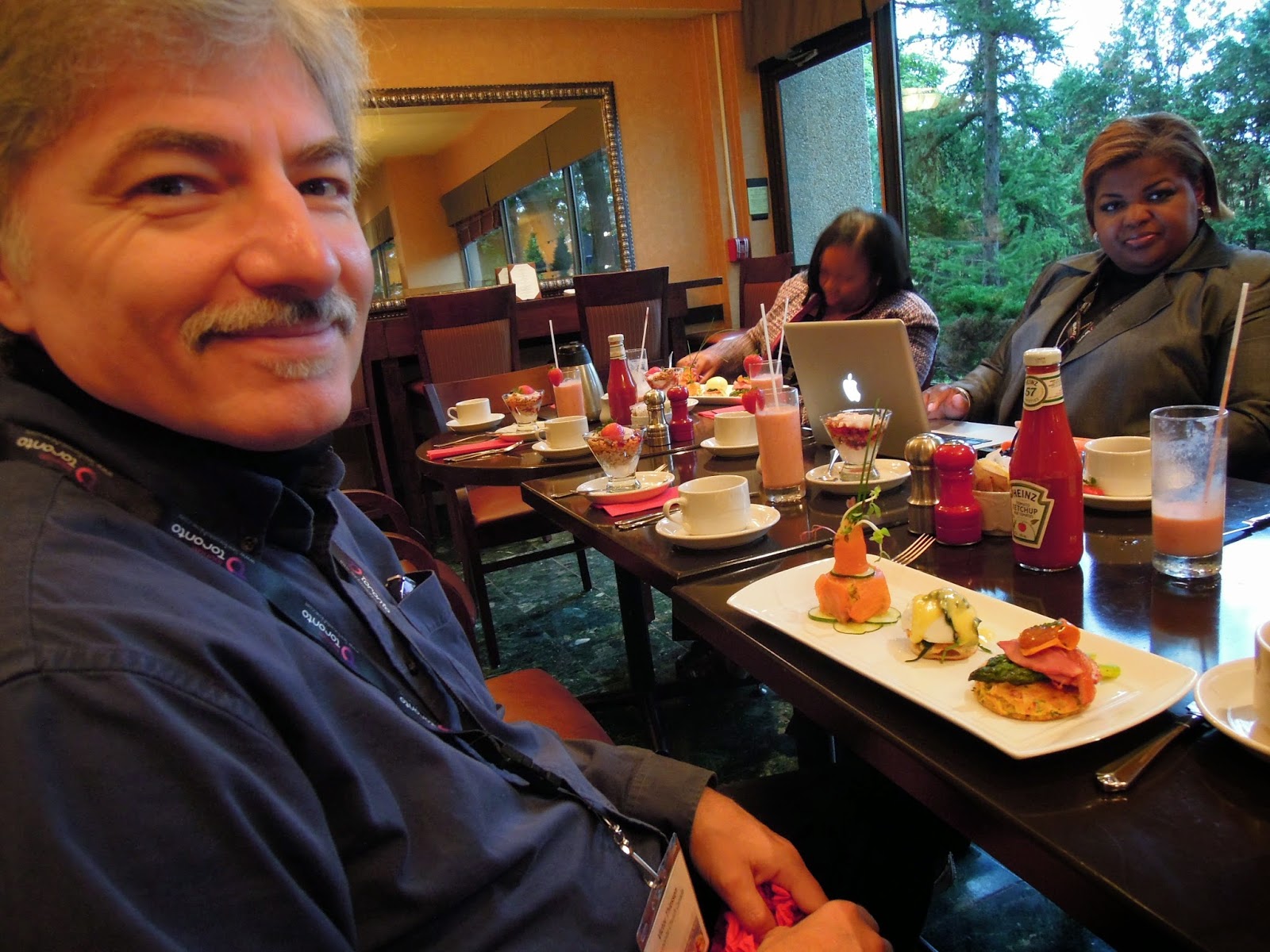
Breakfast Entre.

On Saturday morning I was eating breakfast with the group when one man asked if I visited Toronto very frequently. I said that I had just been here two weeks earlier, in a very different capacity. I told him that I had been staying in Parkdale. He proceeded to tell me that Parkdale was changing from a "bad" place to a very nice place to live. Young couples and students were buying houses and condominiums and making it a "good" place to be.

I sat there listening and feeling sad for the Parkdale that I had experienced just two weeks earlier. Now, maybe my perspective is a little skewed. I walked the streets during daylight hours and I did not see any evidence of some of the less pleasant aspects. But the Parkdale that I saw appealed to me- the life and activity and society of a place to live that is a huge mixture of all kinds of people.


On the other two visits  I stayed in the Christian Peacemaker Teams Aboriginal Justice Team's home in the area of Parkdale, west of downtown Toronto, and  that is quite close to Lake Ontario. The large house that my three colleagues plus two housemates live in is an old lovely duplex that was formerly the Catholic Worker house of hospitality. I have heard stories from my colleagues of visitors:  a homeless couple who lived on the porch for a period of time last summer, of racoons and little kittens or  the lonely CPT guests who drop in for a time to be with fellows of like mind . Some of these visitors have been rehoused quite quickly, others were invited to stay for a while until they were able to find suitable housing. Others made their way back to lives in other parts of Canada or the world.

This is a tiny taste of the Parkdale I experienced.. On my walks I saw a mixture of all kinds of ethnicities and cultures and ages and genders. I saw children spending out-of-school hours playing footfall/soccer together on the schoolyard, women in traditional Tibetan dresses carrying groceries home, and community gardens thriving beside a weekly vegetable market.

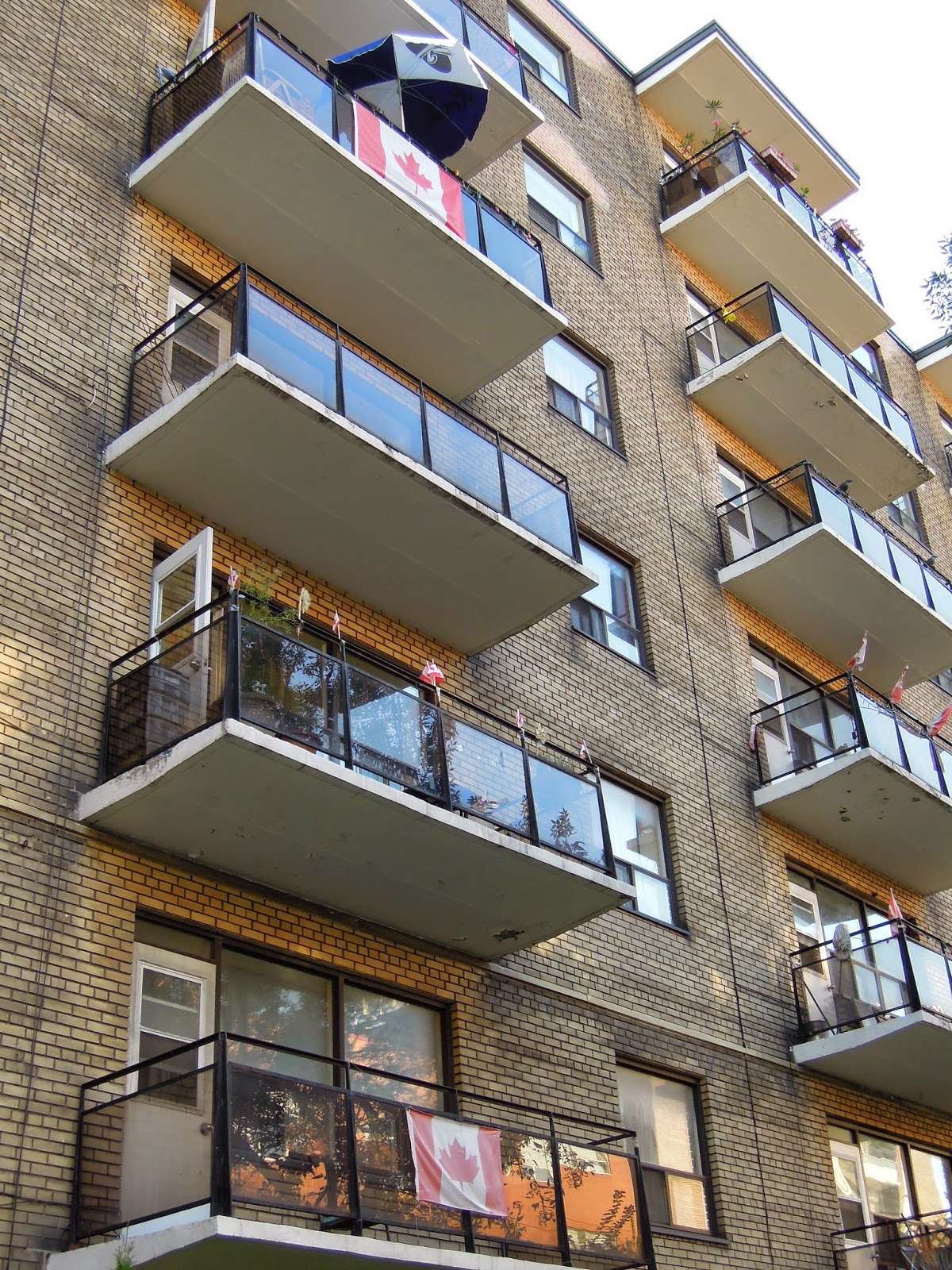
I don't know who lives in these apartments. But I did see of lot of Canadian flags- people making a new life in this country.

However, I witnessed one interaction that exemplified the village that Parkdale is, in the midst of a huge city. As I waited to cross Queen Street I spied an elderfy man walking slowly along the sidewalk. Another man met him and asked if he was going home. The first man mumbled, "yes, yes, going home".

"Then you have to turn around. Your home is that way". And the second man pointed in the opposite direction. "And (woman's name) is hunting for you. You need to go find her." He then turned the man around and sent him back up the sidewalk.

The second man then came to wait for the walk signal alongside me. I smiled at him. He said, "It sucks to have Alzheimers."

This is a place to live where every day you walk alongside new and old immigrants to Canada, old and young people, broken and not-so-broken people. I pray that this part of Toronto will not change too quickly to be a "good" place to live. Because, in my opinion, it is already a GOOD place to live.

Monday, August 26, 2013

On Sasquatch and the fun of oral tradition

"I believe in Sasquatch
just as much as I believe in God
which is not logical
since more people have seen Sasquatch
than have seen God."
(The Sasquatch Poems.... by Sherman Alexie)
 
Two weeks ago I co-led a Christian Peacemaker Teams Aboriginal Justice Team delegation to Kenora, Ontario and Asubpeeshoseewagong (Grassy Narrows First Nations). We spent the first half of the  ten days visiting with organizations in Kenora, attending  Monday morning bail court and observing the commemoration of Cecilia Jeffries residential school. The  next five days we lived in the Trapper's cabin in Grassy Narrows, watched and participated in  the pow wow and had conversations with some of the residents of the community. Some of these were long time friends and partners with CPT. Others had not met any CPT members before.
 
However, there was an unusual running thread through some of the conversations. This was a frequent reference to Sasquatch.  For those of my readers who do not know what I am talking about, a Sasquatch is  a hairy manlike creature reported to exist in the Northwestern U.S. and Western Canada and said to be a primate between six and fifteen tall—also called bigfoot. —(Webster’s Ninth New Collegiate Dictionary) .Now, this may seen strange to those of you who think that Sasquatch  is a fictional creature. The theme of our conversations is that many indigenous people have some belief that they do exist.
 
I also recognized that the tradition of oral story telling is important for passing on knowledge. However, the fun began when we heard the same story twice in two different conversations.
 
The first was a man named B. . As we broached the subject of sasquatch he told us of a devout Christian woman from Grassy Narrows who had doubted that the large primate actually exists. However, one day  she had been out picking blueberries and looked up from her work to see the huge animal. She fainted dead away. When her daughter found her she woke up and told about the amazing thing she had just seen. This was confirmed when they found gigantic footprints, Experts came to make plaster casts of these prints and the evidence was preserved.
 
A couple of nights later S and L came by the Trapper's Centre for tea. Somehow the topic arose again. They began to tell us about a woman who had seen such an animal. I said, 'oh yes, we heard about that incident. The woman was picking blueberries and fainted." They looked at me with astonishment. " No, that is not how it happened." 
 
They went on to say that yes, she was a Christian from Grassy Narrows reserve. But she was driving in her car going to pick blueberries. The sasquatch appeared in front of her car. She did not faint at all. And her daughter saw the beast too. They did make plaster casts of the footprints. But that was not the end of the story. Word got out that Sasquatch had been seen and people flocked to the region to see if they would have the same luck. They moved through the forest and trampled the blueberries. The animal was not seen again.
 
We all laughed at the discrepancy in the story.  The conversation continued when one of the delegates brought out the book of poetry by Sherman Alexie.  She read the long poem about the tales of  sasquatch sightings and the questions it raises-such questions as in the quote below. The whole poem is here. It is worth a read.
 
                                                           "Do you take the bread and wine
                                             because you believe it to be the body and blood?
                                                           I do, as other Indians do, too
                                              because that colonial superstition is as beautiful
                                                        as any of our indigenous superstitions."
 
                                                                      *******************


                                                'When I asked the Indian elder, she said
                                         with a smile, “I don’t know if I believe in Sasquatch
                                                              but he sure does stink.”'
                                                   (The Sasquatch Poems.... by Sherman Alexie)
 
This is not the footprint from Grassy Narrows. This measured 18 inches long by 8 inches wide.
(Photos- Michael Patrick)

Tuesday, June 25, 2013

I asked for peacemakers and no one came...

 
The rooftop of the small monastery in Sulaimani
 
Over the last month  Christian Peacemaker Teams has received requests from at least two communities asking for CPT accompaniment. My colleague Tim Nafziger wrote in his blog about these requests ( article here). CPT has sent people to these areas, but is asking for reservists to continue the  support.

These requests strike me hard right now, especially as Tim mentions Syria in his article. Several weeks ago team mate Pat and I sat down for tea in the small monastery in Sulaimani with a Chaldean priest from Syria. Father Paolo Dall'Oglia has been living and working in a monastery in Syria called  Deir Mar Musa al Habashi for 30 years. I wrote a couple of posts about Mar Musa last year.(here and here).

Father Paolo Dall’Oglio is an Italian cleric with a Ph.D. in comparative religion and Islamic studies. He championed Christian-Muslim dialogue for three decades in a region where the line between state and religion is often blurred. He did it from his monastery some 80 kilometers north of Damascus. “I have worked to  create a monastic community dedicated to the service of harmony between Islam and Christianity,” he says" (taken from Micah Café blog here ).

Mar Musa (near Damascus, Syria) taken by Andres Rump


The community at Mar Musa has also walked the journey of practising and teaching non-violence. In September  2011 as the conflict in Syria was heating up they  called for a week of "spiritual jihad, through fasting, prayer and sakina (God-inspired peace of the soul) for reconciliation between the children of Mother Syria.". They implored for " reconciliation between citizens, on the basis of a common option for non-violence as the only method able to ensure sustainable reform and to avoid the slide into civil war and the vicious circle of revenge."


The people at the monastery pleaded for reconciliation and dialogue. They asked for two things. First, for the freedom of the international press in order to create objectivity though plural sources of media. Second,  they refused to accept military might as a way to supress the conflict. They suggested that " the Syrian government invite the International Committee of the Red Cross and Red Crescent as well as other impartial international humanitarian organizations (such as the global movement of scouts, Gandhian movements or nongovernmental organizations for the defense of human rights) to cooperate with Syrian nongovernmental organizations".


As we sat with Father Paolo that day he expressed that he had a deep affection for the Mennonites. But he hesitated to talk about non-violence. Soon we found out why. After the week of fasting in 2011 they published a document asking for 50,000 unarmed nonviolent  activists of the  global civil society. Dall’Oglio travelled and pleaded with international agencies to send these people to use the window of opportunity. But as he said, "no one came". (In an interview in April 2013 he does say that one group sent 100 peacemakers and another 300, but this was far from enough.. here.) The conflict escalated. Now he is advocating for an armed response on behalf of the opposition. "..Now we should assist the Syrian people in their right to defend itself. A no-fly zone would be the minimum of responsibility. All the modern weaponry is being used against the Syrian people."


Pat and Father Paolo in Sulaimani

I asked him at which point he changed his mind. He said that it was more like an evolution. After the peacemakers did not come the artillery of the regime began to kill the sons of all the people that he had grown to love. Then he felt the time of nonviolent intervention was past. He has received a lot of criticism for his new plea, but he is firm in it.

As I sat there I had many thoughts going through my head. I did not feel equipped to lecture him on the apologetics of nonviolence. He knew them very well and  I have never ever been close to the situation that he has witnessed.  He was expelled from Syria by the regime for his ideas and support for the opposition.

  I thought back to the speech made by Ron Sider  in 1984 that provided some of the impetus for the birth of Christian Peacemaker Teams. He said,
 
 "What would happen if we in the Christian church developed a new nonviolent peacekeeping force of 100,000 persons ready to move into violent conflicts and stand peacefully...  Together the Christian church could afford to train and deploy 100,000 persons in a new nonviolent peacekeeping force. The result would not be utopia, or even the abolition of war. But it might tug our trembling planet back from the abyss. (Ron Sider, 28 July 1984)"
 
The community at Mar Musa asked for 50,000 unarmed nonviolent  activists of the  global civil society. If we, as Mennonites or Christians and others who believe in nonviolence,  had managed to meet the challenge of Sider then there would have been 50,000 peacemakers left over for the conflicts that are happening in other regions of the world- for the Mikmaq nation in New Brunswick and the community of Las Pavas in Colombia and many more. 


Friday, June 7, 2013

Landmines in the fields--an ever present danger

I am reposting a reflection I wrote after a recent delegation that came here to Iraqi Kurdistan. The delegation was made up of 5 German people and a new member of our team.  I co-led it with my son in law Laurens. (Many of our partners had seen photos of my family and recognized him. It led to many mother-in-law jokes as well as amazement that we are also friends.) We could not have done the delegation without the wise advice and translating skills of Mohammed Salah Mahdi.

CPTnet
6 June 2013
IRAQI KURDISTAN: Landmines in the fields--an ever present danger

 by Kathy Moorhead Thiessen

IMG_1701 
Field where the mine exploded 
As the recent CPT delegation climbed the road into the Quandil mountains in Iraqi Kurdistan we felt the coolness of snowfields still present at the end of May.  The tips of the rocky range marked the border with Iran.  We emerged from our minibus in the idyllic mountain village, Kani Spi, to spy the blue tractor moving below us on the field.  It made its way up to the yard and stopped.  Fifteen-year-old Halgurd (named for the highest mountain in Iraq) climbed out.  He greeted us and we all introduced ourselves.
As he spoke to Mohammed, our translator, he quietly and matter-of-factly told us that the day before a mine had exploded under his tractor.  “I was very scared.  But not even the tractor was harmed.  The mine made a big hole deep into the ground.  I was OK too.”  Halgurd’s father lost a leg to a mine and he knows people who have lost their lives to the same destructive weapons.
Later, his father, Mahmoud, told us again about their situation.  The shelling from Iran has stopped for now, and he hopes it will end forever.  However, the mines remain an ever-present danger. 
CPT Iraqi Kurdistan has visited with this family many times and written releases about life in Kani Spi.  The incident of four days ago impressed on the team again that their situation with the mines has not changed.  Mahmoud said, “We must keep a careful eye on our children, especially those who visit us.  Sometimes even the adults get absent-minded and may walk into the area of mines.”
IMG_1703 
Halgurd and two CPT delegates
sitting at the head of the
White Spring ("Kani Spi" in Kurdish.)
 
He requested that we go to the office of the authorities who are in charge of mine clearing in the region to ask them if they would come again to Kani Spi.  He said, “The mines that are far away on the mountains do not bother us.  We can avoid them.  But there are mines close to our house and we have asked them many times to clear them.  They still have not come back.”  He also asked that they come to look again at the field,although it was cleared again last year.  The mines have been there since the Iran-Iraq War in the 1980s when the mountains were littered with these tiny, inexpensive, and volatile weapons.  The weather and seasons sometimes bury them deep or bring them to the surface.  Then an incident can happen like the recent explosion.
That evening, we spoke with his wife, Maryam, and expressed our gratitude that the detonated mine had not harmed Halgurd.  “Thanks be to Allah,” she said.

The next day the delegation stopped at the mine clearing office in the nearby city.  We presented the director with a letter asking him to consider working again in Kani Spi.  We have not yet heard his reply.

Wednesday, May 15, 2013

Basta, beautiful Basta.

A week ago I had the privilege of going to a place where few non  Kurdish people have been. There is a tiny village named Basta that is in the foothills of the Quandil mountains. From our friend, Bapier's house you can see the peaks that are the border of Iran and Iraq.


Bapier has  invited the team to visit many times. But unfortunately, the village is past a line  that the Iraqi Kurdistan security forces are reluctant to let us cross. We are not sure why they have a problem. Maybe they think that we will be in danger? This time Lukasz and I had friends with us who knew who to phone. So, after a number of calls, including the mayor of  a larger town, they let us through. But they did keep our residency cards to ensure that we would not flee over the mountains to Iran (I guess).

The day showed the glory of spring.

The highest mountains still had a covering of snow, but we could feel the heat of the sun beginning to exhibit its strength and the fields were green, green, green.  Bapir was so excited that we were finally able to come to his village. invited us into his simple house and we sat on the carpet in the sitting room. His older daughters stayed in the kitchen, but the middle ones came and served the tea.


 The little boys wandered in and out. There was a mild problem when I shared some little plastic dinosaurs with them. The "roaring of the animals" caused Bapir to gently push them out of the door with a command to play elsewhere. It worked for a few minutes, until they came back to see what else of interest the visitors might have.
Two of Bapir's sons and Angel (our friend)'s brother in law looking at the marvels of games on a mobile phone.

We asked Bapir how he felt about the recent cease fire between the opposition forces and Turkey. If this really happens it will have a massive positive effect on this village, like many others along the border regions. CPT has supported the villagers of Basta since 2006. Every summer he village has emptied  as the shelling and bombing season started. They evacuated to  an Internally Displaced Persons tent camp further down the mountain beside a rushing mountain stream. Summer 2012 was the first growng season in 7 years that they were able to stay beside their animals and gardens. It was was also the year that the Kurdish Regional government finally provided more permanent dwellings for the camp that have remained empty. Bapir dreams of the day when his family will be able to be secure enough to stay in the village with him.


Bapir and me and his little son.
 
 
This is a brand new mosque that the villagers have built. It is almost finished and will provide a place for prayer.


They served us  a lovely meal of chicken, rice and a soup called quirew that is made out of yogurt and spices. We have been told that this is a very special soup made for guests.

Then we went out for a tour of Basta.
 

This is the second house we visited (and had our 4th cup of tea). The man in the dark brown Kurdish suit is the sheikh of the village-another leader.
 
 
A reminder of a scarier day in the village. Schrapnel from shelling came through the window into the house.
 
 
Bapir's daughter climbed the kezhwan tree to get the green fruit for us. They were a little sour and made the mouth pucker up. I ate a few for the experience and then gave the rest of my bunch to my little friend.
My little friends. The one in the yellow shirt desperately wanted to stay with me, even when I had the use the toilet. It was a 3 sided enclosure without a door. I tried to convince him it was a bad idea, but it took his sister to hold him back so I had a vestige of privacy!


On another visit Bapir had gifted Lukasz with a traditional men's hat. So L. gave him a CPT cap. I guess this daughter decided that it was perfect for her.
 
At the last house we visited we were offered "mast-aw" (yogurt mixed with water). A refreshing change to tea.
In the days before Sadaam Hussein's "Anfal"- his attempt to eradicate the Kurds, Basta had 75 houses. Now there are 21.
 
I was curious. I told the young people present at the second house that often in Canada the young adults can not wait to get out of the villages and to go to the city. I asked how they felt about being in the village. They all replied that this was the place they loved. They hated the city and wanted to live in the mountains despite the remoteness. Many of them work as shepherds or caring for other livestock.
 
The villagers still are not secure that peace will come. They are waiting to see what how the neighbouring countries will handle the agreement and whether the bombing and shelling will be finished for ever.


Tuesday, April 16, 2013

My husband has 1/2 a wife.....

Today was one of those days that makes me love my work. The team had decided to visit one of our contacts who is a mullah/imam/leader of a Muslim mosque to pay our respects. His brother had died a month ago and it is the proper thing to do. Unfortunately, when the time came one of my team mates had spots all over his body from a silly virus and the other had stomach problems. So I went with Mohammed to the house attached to the little mosque.

We were greeted by the mullah and his two tiny daughters. We met one woman and then his wife. After we were settled with glasses of water and cushions to lean against, Mohammed expressed our sadness at the loss of his brother. Then the cake with  tea and bowls of watermelon came out of the kitchen . The two women sat down against the wall on the other side of the room to listen. The conversation went back and forth: Kurdish, English, English, Kurdish. Then M. looked at me and said, " this woman is his second wife. They were married six months ago". I could tell they all were looking at me for my reaction. I smiled and put my hand over my heart. They smiled back.

We talked about fundraising; how CPT gets its money. Does it get government funding for rent or food? M. said  that we did not and then went on to explain how individuals give money to CPT for our work. I asked M. to tell him about my fundraising suppers and they were thrilled by that idea. They asked what kinds of Kurdish food I had prepared and were suitably impressed. However, they thought that if they tried such a thing here- make a meal and then tell people they had to pay for it- they would never come back!

After more conversation I decided to be bold. I asked if I could ask the women some questions. They agreed readily. So I told them about how I had been the daughter of a Christian pastor (mullah) and sometimes my mother found it hard to be the wife of a pastor. I asked them how it was for them and if they found that the community expected them to be better than most women. They both agreed that it was good to be the mullah's wives. They did feel higher expectations, but  explained that they knew he was in that position when they agreed to marry him. They all played and cared for the little girls while they talked.

I have never really had occasion to think about polygamy. But it did not matter at this point. We were talking and sharing our stories together. Mulah asked me about my husband and children. I explained that now my marriage was unusual in my culture, with me being here for 1/2 the year. He listened well to my story of how we came to the agreement that I was to do this work here in Iraqi Kurdistan.

But, I thought to myself, "hmm. right now Vic (my husband) has 1/2 a  wife and right now the mullah has 2x ."

Before we left, I had agreed to come back to their house to learn how to make Kurdish bread and cake from the wives. The idea is quite exciting, but so stretching to think of spending a whole day with my limited Kurdish and their  lack of English. But I promised to bring my dictionary and I think we will do well.

Monday, March 4, 2013

Guest post: Iraqi Kurdistan: Nonviolence 102

( Dancing part 2 and 3 are still to come, but here is a reflection by team mate Annika. The team has done 4 of these workshops so far in high schools, and plan a few more before school closes this year. It is very exciting to me as we had dreams of doing this last year. Now it has really happened with great evaluations from the students).


IRAQI KURDISTAN: Nonviolence 101
by Annika Spalde
The classroom was cold and crowded with old and squeaky benches. We began moving them aside a bit, to make room for the exercises. A group of girls came in and eagerly sat in the front benches. "Oh, there's no electricity! We can't show them the film clips that we've prepared!"
"Some of the students need to take a bus at twelve o'clock, so there's only fifty minutes for the workshop," said one of the teachers. Hmm. We had asked for an hour and a half…. More and more students come in. We had agreed on forty but I think that there were sixty or more. Okay, we say to one another, let's do the best we can under the circumstances.


After a short introduction of us and CPT, I start with the first exercise, the spectrum. "Those of you who believe that there is a lot of violence in your society, you put yourselves on this end of the line. If you think there is not a lot of violence in society, you go to the other end." They come up, and most of them go to the "a lot of violence" end. "Why did you put yourself here?" I ask the guy standing on the far end. "Yes there is a lot of violence," he responds, "for example in the homes, against women." Another says, "Some people have the possibility to go to fancy hospitals abroad if they need care, most of us can't do that." A third student says: "There is also psychological violence, like when someone speaks in a degrading way to another." They give several more examples. I'm surprised at how quickly they think of different kinds of violence, and how eager the children are to share their thoughts.
Lukasz takes over the facilitation, "So, how are we, as a society, going to move from this side to the other side of the spectrum? There are two common reactions to violence. One is to respond with violence, the other to run away, or just look the other way. Nonviolence is a third alternative. It means to fight for justice and peace without the use of violence." The students had ideas about how to do this. "We need to learn more ourselves. We need to educate people about nonviolence." Mohammed and I then shared briefly about Gandhi, the principles of nonviolence, and some nonviolent methods. In the beginning the atmosphere was kind of messy, but by now everyone was listening attentively.
Afterwards when Mohammed read aloud from the students' written evaluations, I felt happy and grateful. "It should have been longer!" one student wrote. "I have learnt that violence only gives rise to more violence," said another. "You forgot to mention sexual violence." "I want this kind of workshop every year." Maybe we have sown a few seeds, even if this time the workshop was so short and a bit chaotic.


Monday, February 4, 2013

Singing to an Unseen Audience


(Photo- Sandra Stevens)
 

Three days ago  I was a singer in a choir to an unseen audience. The stage was a sidewalk outside of a deportation centre in Chicago, Illinois. The audience was hidden safely behind large garage doors and blacked out glass in six vans. I wondered if the safety is for them, us, or the system that tries to hide the fact that 425,000 undocumented workers in the US are whisked out of the country every year. It does not matter if they act like good or bad people, they are sent away. The choir sang in somewhat croaking three part harmony- "Courage, migrant brother,/ you do not walk alone/ we will walk with you/ and sing your spirits home.”


The current CPT training group braved the bitter cold wind as they attended the weekly vigil at Broadview Detention Centre. Broadview is a detention center run by the Chicago office of the U.S. Immigration and Customs Enforcement (ICE). Every Tuesday and Friday the bus and vans are loaded with men and women who have been rounded up in raids on their homes or workplaces. Many of them leave behind loved ones. They ride in shackles on the bus to the airport to be flown to a land considered to be their homeland, but which many of them have never lived in. One of the delegates, Cory Lockhardt, wrote in her blog about her experience.  http://www.trulylovethyneighbor.com/2013/02/courage-migrant-brothers.html?spref=fb


As I experienced this action today I was taken back to my own training in July/August 2010 on a much warmer day. In my notes that I saved in my gmail drafts  I noted that we had met two of the nuns who had fought the system  to gain the opportunity to pray with the detainees before they were sent off to the airport. I wrote, “ I am so I shocked that in this "Christian nation"  they had to fight for two years to be able to pray for these people on the buses.” These nuns asked us to stay within the guidelines, to not plan surprise civil disobedience or some other resistance. For them the important goal was to make a weekly presence and to provide a small bit of psychological support for the men and women who were leaving their homes. We found out that early in the morning they were also allowed to visit any detainee who wished and gave out cards telling them where they could get physical help when they were unshackled and pushed out into the country on the other end.


 I entered one of those buses along with the young man who would become my son in law and another trainee, to pray with and for the persons there. We wanted them to have an image of someone who cared as a lasting picture of the USA. We could do nothing to change their situation at this time, but we could pray with them and let them know that someone knew of their grief and cared.


As we entered the bus and yelled through the plexi glass barrier (because the intercom did not work) introducing ourselves, the whole busload erupted into clapping . That felt so strange. They were thanking us for coming to say goodbye to them. As we spoke our names one man lifted up his handcuffed arms and pointed to the shackles around his waist and ankles and said, “They treat us like criminals. We are not criminals”. We told him that we knew this. Then we read a short statement that we had prepared and that was translated into Spanish by our team mate. We said the Lord’s Prayer together, joined by most of the people on the bus. Then we stepped down to the ground.


Next we were taken to a van that held 8 men being sent to some Central American countries.  Here we were separated only by a grating and we could speak in normal volumes. As I was introduced as being from Canada, a young man right next to me quietly asked, “What is Canada like?” Searching for the correct thing to say I answered, “Canada is good”. He said softly, “I wanted to go to Canada”. I almost lost my resolve to stay calm.  I could not say that Canada would treat him any better. He had shackles and handcuffs just because he had crossed an invisible line in the sand and tried to stay on the ‘wrong” side.


On that summer day in 2010, after the bus and van had driven away, Laurens and I stood with the rest of the vigil, arms around each other and silently weeping. This was not our country, but we knew that in Canada and the Netherlands such scenarios take place as well. I thought of the privilege I had of owning two passports that gave me such freedom to choose where I lived.


Three days ago, as I sang in the choir to the unseen audience, I heard a gentle clinking sound. I turned around to see a man exiting from a car carrying a large armload of chains and shackles. I imagined that he had been there when they released a group of people, and was bringing them back to the centre to put them onto some of the 1000 detainees in that building so they could be sent out.


The three trainees who were in the parking garage praying on this cold day told us that when the large bus sized garage door lifted they could hear our voices. That means that possibly some of the detainees beginning their journey could also. We sang the song over and over, despite voice fatigue and freezing toes, hoping that in some way it would send them on their way with a tiny bit of hope.

Saturday, December 29, 2012

On Kurdish children and the Feast of the Holy Innocents

Yesterday I was honoured to have my friend Chris Sabas nominate me for CPT's, "Twelve Days of Christmas" peacemakers. It was published on "Christian Peacemaker Teams" Facebook page  on the 4th day of Christmas which is known as the Feast of the Holy Innocents. [the day that the Bible tells of King Herod killing many children in his search for the child Christ]. This is because some of the writing I have done while on team in Iraqi Kurdistan has been about the impact on children of violence (especially the bombing and shelling). The link to the site is.
https://www.facebook.com/home.php#!/photo.php?fbid=529570520396174&set=pb.119985174688046.-2207520000.1356798464&type=3&theater
I hope that those of you without FB can still open this. If not please send a comment.

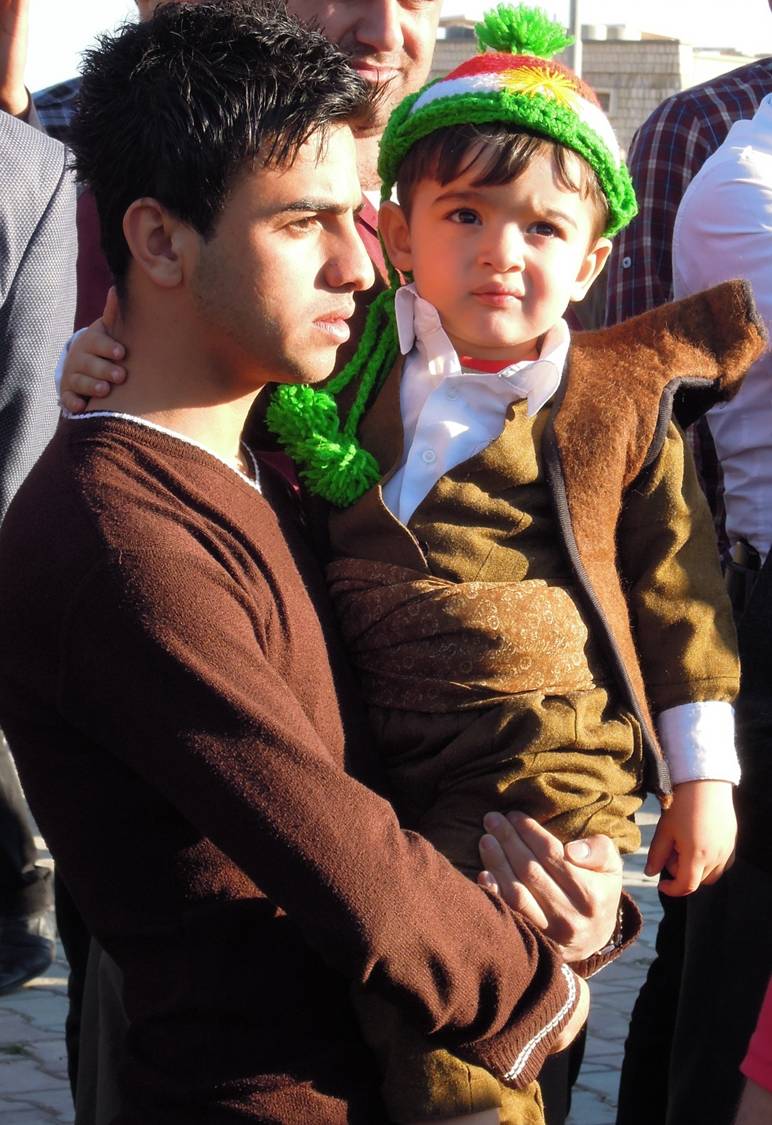
As I remember so many of the little ones I have met while in Iraqi Kurdistan or some of the ones I have seen just for a minute, I want to post some of the photos I have taken. It is strange to walk the streets here in Winnipeg and to have children look down as I walk by. I am so used to being greeted and spoken to by the Kurdish children. Of course, I realize that I am an unique sight there. They can tell just by looking at me that I am a foreigner and they are curious about me.  I really enjoy taking the moment to talk to them. Usually they try to speak English and I try out my Kurdish. This is a bit complicated sometimes but fun.


This is a child that I did not meet. It is a statue in the town of Chamchamal in memory of 11 year old Germian. He was shot by security forces during the early days of the 2011 demonstrations in Sulaimani province.