Pages

Showing posts with label Kurdish Northern Iraq. Show all posts

Tuesday, March 13, 2012

Yipee, I had a real Kurdish conversation

I had the most unexpected visit today. I was heading out to the bazaar to go shopping. About 5 minutes from home (after passing a cow rummaging through the garage), I saw a mother sitting by the side of the road with her baby. I stopped to ask whether i could take their photo.

As I was speaking to her, an older woman came out of the house across the street. She walked over to us and asked me the usual questions-"where are you from etc". Then she asked if I would like to come in for tea. Scary moment, then my latent impulsiveness kicked in and I said -"bulay- yes". So we went in and met another woman. They seemed very thrilled that I was coming to have tea with them. (As it turned out I was the only one who had tea- but that was OK). We proceded to have a real conversation. All about children and where I live and what I work at. The grandmother told me that 3 of her children had been killed in 1988  in the chemical bombingt in Halabja. Of course there was a lot I did not get, but that was OK with me and them. We just worked at it and understood what we could. It was a little disconcerting when the husband who obviously did not know I was there came from the upstairs in his boxers and undershirt. But he seemed to take it into his stride and quickly went to get dressed. Then he took a photo of all us- 3 generations and me.


Eventually, I somehow told them that I needed to go shopping and they let me depart. On my way home from the bazaar I saw this row of men sitting on the wall beside the main road. They are street cleaners who  work throughout the city with a broom, shovel and a wheelie bin. Usually they wear a scarf tightly wrapped over their face to protect from the dust and car exhaust. I think of them as the invisible people as most people do not even acknowledge their presence (and essential work). Here they seemed to be taking a break and relished the thought that I wanted to take their photo. They thanked me greatly when I showed it to them.


Saturday, March 3, 2012

Kurdish Northern Iraq first school shooting

I have observed and listened ever since Thursday when our friend Mohammed arrived at the house to tell us that something bad had happened. In a local private school a highschool student had shot his American teacher and then committed suicide. I think I am hardened. It did not really make an impact on me. (And later the director of education was reported to have said, "this is normal. It happens in America all the time".)

I was shocked 3 hours later to find an article on the Winnipeg Free Press website .http://www.winnipegfreepress.com/breakingnews/iraq-authorities-say-american-teacher-shot-in-apparent-murder-suicide-in-kurdish-region-141012513.html  I wondered if the story had flown so quickly because the victim was an American. Would it have done so if a Kurdish boy had killed a Kurdish teacher?

Any way it is now 3 days since it happened and we are finding that the city is extremely shocked and is reeling from the situation. Teacher Jeremiah Small who had been teaching at a private school here apparently was involved in an argument with the 18 year old student and in the middle of class the boy had taken out a handgun. Reports from the students are not consistent. Some say it was about religion, others say it was nothing to do with religion. Nobody seems to know why the boy was provoked to do the act and then to turn the gun onto himself.

It is known that he is from a very influential family- one that could have worked probably very easily to smooth over the crime. It is also said that Mr Small was careful not to preach Christianity. It is a Christian school but parents know this when their students are enrolled.

Today, we were asked by a group of our partners if we would help them to plan some sort of action with regard to the death of Jeremiah Small. We felt uncomfortable with this. We did not know the man or the boy but we consider that there are two victims in this. The boy of a  society that seems to consider handguns to be an Ok thing to carry around (we have been told by our partners that members of the goverment leadership have given gifts of over 25,000 handguns that don't have to be registered because they have a special exemption seal on them). The man is obviously a victim of this ideology as well as of a boy who seems to have been disturbed for some reason.

We suggested that an action had to be done to remember that both were victims, but the Kurds we know are not ready for this. They are very angry at the boy- some even spoke of hate. We hope that sometime they will be able to move out of this. We hope that someday the handgun will not be a typical piece of apparel-- here and in America.

Monday, December 12, 2011

An acoustic post

My team mate Patrick created a short video for his blog. He has graciously allowed me to use it for mine. It is a glimpse of a moment in time in Rizgary Taza in Suleymania, Northern Iraq. We live a few houses down from this mosque so get to listen to this this wonderful muezzin several times a day (most of us now sleep through the one at sunrise). It is quite regretful when he gets a cold or has a holiday and someone else (much less musical) takes his place.


 Let me know if this works..

Tuesday, December 6, 2011

On stitching and weaving and sewing..

When I was here in the spring I made a post about signs of quilting (June- "Searching for signs of quilting). On this stint I have continued to look for handwork of any kind and I have found some more. But.. they are still very scarce. I keep thinking that I may find a group of women sitting and stitching together, or a home with a weaving loom or some men carving. But I have not found this at all. I did find some explanation for this on the website of the Kurdish Textile Museum in the capital city, Erbil/Hawler.  (http://www.kurdishtextilemuseum.com  ) 

"While it is good to appreciate the weaving, there is another aspect to highlighting the art from this region. The Kurdish people face the threat their culture may disappear altogether. Iran-Iraq war in Kurdish land, Arabization [moving the Kurdish people out of communities and Arab people in] and Anfal (the genocidal campaign waged against Kurdish people by the ex-Iraqi regime) destroying more than 4,000 Kurdish villages, forcefully resettling nomadic and settled tribes as well as millions of mines planted throughout Kurdistan, banning of agricultural planting and breeding herds, have all contributed to the devastation of this culture and its economy.

This extermination of a way of life continues due to the bombing and shelling that is happening in the border regions from Turkey and Iran. Villagers are leaving the villages as internally displaced persons during the bombing season (from planting to harvest). Many do return to their homes but many give up and leave for good, heading to the larger centres and cities.

But, when we visited the small Christian Assyrian village of Merkagia , near the Turkish border, I spied a tattered patchwork quilt  in an empty house that the female team members were staying in. I grabbed it and asked a neighbour about it. She said that the old women used to make such things, but now everyone wants store bought blankets so no one makes them anymore. Our host, N, overheard our conversation and asked me if I would like such a blanket. He went into his cupboard and brought out a much nicer specimen and offered it to me. I was very excited and gratefully received it. Technically, it is not a quilt, as it only has 2 layers, but I think that it is beautiful.
 The first patchwork blanket that I found
The blanket that I was given by N.
Then, a few days later I spent a week in Ranya. There I had time and quiet to work on my Kurdish. I discovered that my friend Nishtiman has a sister who has been a seamstress for 12 years. Her main income comes from sewing traditional Kurdish dresses. When I said that I had been looking for a way to get a traditional Kurdish dress for my daughter she volunteered to cut out the dresses for me (they do not have patterns, but know how to cut the fabric according to measurements). So I went out to find fabric for two dresses and she cut it out for me one evening. 

Sharaban measuring the main part of the dress.
 Sharaban also makes the informal dresses like she is wearing.
I think that she and other Kurdish tailors and seamstresses are very talented in saving the traditional ways of sewing their traditional clothes. She does use a sewing machine but all cutting is done with a measuring tape and scissors.
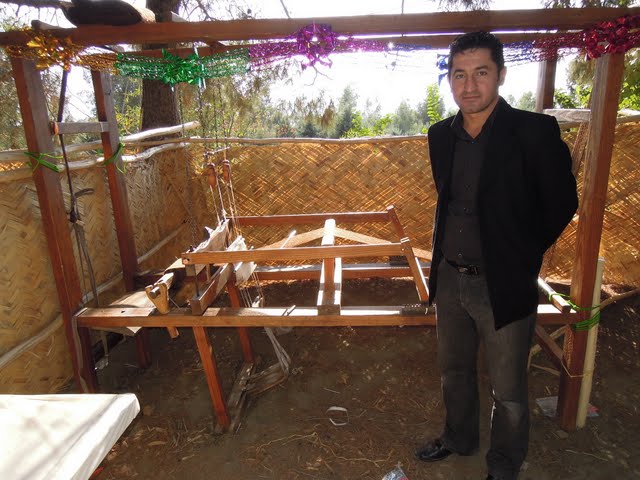
Then, a week later I was invited to visit an agricultural exhibition. Most of the exhibitions were of honey, but there was an example of salmon fishery, grains and fertilizers and in one stand a loom was set up with goats hair to weave the traditional fabric for men's suits. The cloth is around 6-7 inches wide and these strips are sewen together to create very traditional suits. He said that they cost $1,200 to buy as they are so labour intensive.
Finally, in a mountain village, Sunneh, that has experienced shelling this summer and fall, I saw an example of a student's handwork. This is an example of the kind of embroidery that has been done in the past. May this kind of learning continue.
PS. To my sewing friends. I will be making a bag for Sharaban to give her on my next trip. However, I would also like to bring her some sort of sewing item that she would be not able to get here. This would have to be something that would continue to be useable (eg. not a cutter and mat as she would not be able to get new blades here.) Any ideas?


Thursday, November 17, 2011

An Apple a Day...

This is a repost of a reflection that I wrote last week for CPT Net.  I will include a few more photos of the village. (Unless otherwise stated, the credit for the  photos goes to team mate Marcus Armstrong)


IF AN APPLE A DAY keeps the doctor away why can’t thousands of apples hanging from acres of trees keep bombs and shells away?  Why are the rosy apple-cheeked children not running through the orchards, plucking ripe fruit from the abundant trees?

These were the questions that we, the CPT Iraq team, and the autumn Iraq delegation asked ourselves as we visited the  mountain village of Merkajia.  Merkajia is the only majority Christian hamlet in Northern Iraq.

Images from the village's little place of worship.


  One Assyrian Christian family fled to the valley from a massacre of Christians in the years preceding the fall of the Ottoman Empire (1915-19. )  This family grew to over 100 households.
Our host, N., told us of his family’s history on the land.  They had planted hundreds of fruit trees, especially apple, grape, and quince.  These crops have been destroyed several times through various Iraqi and Kurdish conflicts over the years, but the villagers have persevered, replanted orchards, and rebuilt houses. 

The village looked idyllic.  Apples were hanging in abundance, as were grapes in huge purple and green clusters.  The water of the Kani Rush (Black Spring) encircled each tree—an ancient irrigation technique.


Irrigation from Kani Rash  (Kathy T)

  As we roamed the orchards with N., he plied us with all the varieties of fruit, urging us to taste and to learn that each was better than the last.


This tree was so heavy with fruit that it cracked.  (Kathy T)

 Grapes hanging in huge bunches
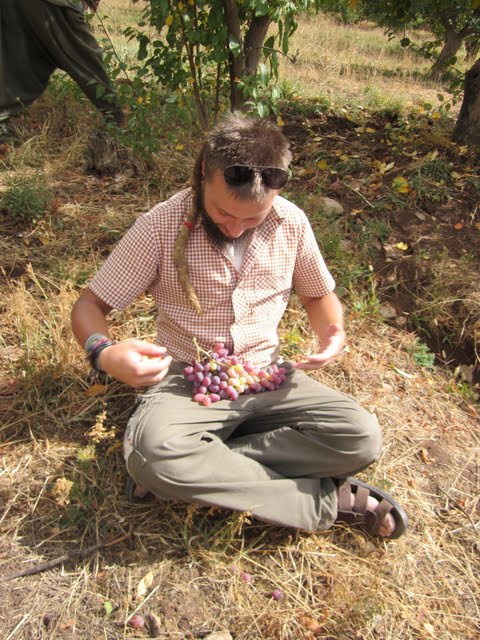
Team mate Lukasz with a lapful of grapes. (Kathy T)

But N. is living alone in his house.  His wife and children are in a city two hours away.  The village is in a valley on one side of the border mountains between Kurdish Northern Iraq and Turkey.  The sparsely treed peaks are the territory of armed fighters, trying to protest the oppression of Kurds in that country.  To retaliate, Turkey sends military jets over the mountains in an effort to eradicate this opposition group.  The civilian villages are caught in the middle.

Thus, the stony roads of the community are now bereft of children’s laughter.  N. longs for the day when his family can be together in the village again.  However, this reunion will not happen until summer when school in the far away city ends for the older children.  And then, the shelling will probably begin again as it has for many summers.


N's neighbors. They plan to leave the village before the snow flies because of health factors and the isolation that the snow brings.

The delegates and team members repeatedly volunteered to help harvest the mighty bounty of fruit.  N. was reluctant to show us where and how to do it.  Finally, he was honest with us: “There is no market for the apples,” he said.  “Fruit from foreign orchards can be brought into Kurdistan more cheaply than I need to make the harvest worth my while.  Maybe someday soon there will be a window of opportunity when I can sell my apples, but that time is not now.”  So we had to be content with carrying two crates of apples back to the CPT house with us to share with friends and neighbors. 

 People from a city two hours away come to buy and pick some apples to try to sell in the market.


P.S....N. has a garden area beside his house. It is surrounded by chicken wire fence. I asked if they have trouble with deer or other creatures eating the produce and flowers. He said, "No, that fence is to keep the dogs away. I have Muslim friends who come to visit and when they want to pray I have a clean place for them to do it. If the dogs had been on that grass they would not be able to pray there". A very simple way to care for his friends who have a different faith than he does.


 A magnificent breakfast 

In gratitude for his hospitality we gave him a Bible.
An image from N's garden 

Saturday, November 12, 2011

A simple explanation of the bombing and shelling of mountain villages of Kurdistan

(Photo credit: Marcus Armstrong)

(Photo credit: Marcus Armstrong)


Two days after I arrived back in Kurdistan (14 October), we closed up the CPT house in Suleymania and headed north on a public bus to join a 4 person delegation. In Ranya we met our bus driver, Aron and his 14- seater bus. Fortunately, there were only 12 of us together with all of our luggage. It made for some squishy travel arrangements when the rain fell and we could not put the baggage onto the roof. But, as I kept reminding them, at least there were no chickens or goats!

The mountains of the Kurdistan are amazing. They are rugged and many shades of brown. There are not many trees. Some reasons for this have been given, including that Sadaam Hussein chopped many trees down to decrease the hiding places for the Peshmerga, Kurdish resistance fighters. After that Sadaam applied sanctions on the Kurds at the same time as they felt the consequences of the sanction on Sadaam and Iraq by the United Nations.  In order to have fuel, they used  wood from remaining trees. Some reforestation has been implemented, but usually there are few trees to be seen.
A wonderful panoramic shot taken with team mate Lukasz
(credit: Marcus Armstrong)


Our trip took us up to the border regions of Kurdistan. The borders of Iran and Turkey have been the site of a lot of bombing and shelling this year. The reasons are plainly stated, but the history is not so easy and uncomplicated.  We have  been tolds that the Kurds are the largest ethnic population without a country of their own. Before World War I they had been living in areas of this region for centuries (and longer). The subsequent treaties and decisions at the end of that conflict split the Kurdish population into bits. Britain drew lines that created the modern borders of Turkey, Iran, Syria and Iraq right through the Kurdish areas. Out of all of these, the Kurds in Iraq have come out the best. They have been granted the opportunity to have a semi-autonomous government (I understand it as something like our provinces, although that image is probably more wrong, than correct). In the other regions the countries have wanted the Kurds to assimilate and to speak the region's language and to act in the region's way.
The mountains around the village of Suneh where we have accompanied the villagers this Fall
(Photo credit: Patrick  Maxwell (delegate))


This has caused frustration and anger leading to people becoming  resistance fighters- trying to tell the authorities that they don't appreciate being oppressed. These men and women have claimed the mountainous regions as their place of safety and home.  In return  for violence committed by the resistance fighters the leaders have turned to bombing and shelling into the mountainous regions, trying to rout them out and eradicate them.

This is where the villages come into the story.  The mountains have also been the home of small communities of subsistence farmers and nomadic shepherds. Some live in the mountains all summer and fall, then move down to lower latitudes for the snowy months. Others have adequate enough roads and houses that they can hunker down during the cold, preparing for the earliest time they can begin to plow and sow.
We are entering the village of Suneh


The men of Suneh are repairing the corner of the school that was hit by shells this summer. Fortunately, the children were on summer vacation. (credit: Marcus Armstrong)
But, this is when the shelling and bombing begins. As soon as the snow clears and people are on the fields, the planes begin to fly over (from Turkey) and the heavy artillery is pointed their way (from Iran). The vllagers don't know when a rocket or bomb will come close enough to hurt them so they escape from their villages down to the valleys. However, during the time they are away their houses are damaged by the rockets, their crops wither due to lack of frequent irrigation and their opportunity to earn a livelihood disappears. Also, they are forced into tent camps by the side of roads and rivers with minimal provision for their basic needs. In recent days some villages have been directed by the government  to return to their homes from the tent IDP camps. Government workers have forcibly removed all aid such as water tanks and generators. However, other villages are still being heavily bombed so they  are scrambling to create winter-secure tent dwellings as I write this.
Internally Displaced Persons (IDP) tent camp where the families of Suneh spent the end of summer and the Fall.


In my next blog I want to tell a couple of stories of people that we met from these villages. 


Friday, September 23, 2011

Heading back to Northern Iraq

What an amazing summer I have had in North America. Winnipeg has been hot, sunny, dry with no mosquitoes.  Some of those things are not necessarily good in the scheme of things, but they sure did make for a few months of great outside working and playing.

I had hoped that this would continue until I was able to have my fundraising supper in our back yard. BUT it did turn cool (although it did not rain) and people spent the evening wrapped in blankets and some even borrowed parkas.

To backtrack.
This summer I met some members of a Kurdish community here in Winnipeg. I hung out with several of the women a couple of times. The goal was to work on my language, but I found it quite confusing as they all came from different parts of Kurdistan so the way words are said or even sometimes the words  are different. They did help me with learning to say some sounds, but I have a long way to go.  It was really fun to meet with them.

So when I planned my fundraising supper I remembered that K had said that she made Kurdish bread. So I was presumptuous and phoned her to see if she would be willing to make bread with me before the supper. She was very willing, so I went over to her house one morning armed with much flour, yeast and salt. (She said we could use her water!)

Here are some photos from that morning:


Onto the round serving tray bread pan with holes dug with the fingertips to prevent air pockets.

Me, trying my hand at doing the same process. She kept encouraging me, but mine were not round and were lumpy!

Baking under the broiler in a normal oven


The end result- 19 wonderful round breads.

Then, came the evening of the Kurdish supper. My wonderful support community pitched in to help with prep work. Yvonne and I prepared: dolma (or as the Kurdish call it- yaprax), cucumber and tomatoe salad, Qaysi (apricot soup) with rice, BBQ chicken shish, with date Kullicha (date filled cookies) for dessert. There was plenty of food for everyone and at tea time we all crowded into our recently renovated kitchen and livingroom to warm up and hear about CPT's work in Kurdish Northern Iraq.

Lining up for the food.

Dolma (peppers and grape leaves), salad, chicken shish kabobs
Qaysi (this was a huge hit with the little people) and bread


Vic, hard at work at the BBQ
Everyone seated on our "lawn" (the dry summer has reduced it to brown grass, dandelions and thistles) in the backyard


The evening was a great success and brought in almost $1900 (Canadian dollars ) for CPT.

In case you were not able to come to the fundraiser and would like to donate to CPT, here is the information.

 If you like, you could put mention my name and it would go toward my work here in Kurdish Northern Iraq.

USA OFFICE: Box 6508 · Chicago, IL 60680-6508 · · E-mail: peacemakers@cpt.org
CANADA OFFICE: 25 Cecil St, Unit 307 · Toronto ON M5T 1N1 · E-mail: canada@cpt.org
To donate via credit card go to http://cpt.org/participate/donate  (I am not sure if you can designate via this route. You could send an email to CPT telling them how much you donated and to whom it is designated).

On Sunday 25 September Vic, Katrina and I will fly to Amsterdam to participate in Janelle and Lauren's wedding. Then on 13 October I fly on to Istanbul and then Sulemanyia.