Pages

Saturday, March 3, 2012

Kurdish Northern Iraq first school shooting

I have observed and listened ever since Thursday when our friend Mohammed arrived at the house to tell us that something bad had happened. In a local private school a highschool student had shot his American teacher and then committed suicide. I think I am hardened. It did not really make an impact on me. (And later the director of education was reported to have said, "this is normal. It happens in America all the time".)

I was shocked 3 hours later to find an article on the Winnipeg Free Press website .http://www.winnipegfreepress.com/breakingnews/iraq-authorities-say-american-teacher-shot-in-apparent-murder-suicide-in-kurdish-region-141012513.html  I wondered if the story had flown so quickly because the victim was an American. Would it have done so if a Kurdish boy had killed a Kurdish teacher?

Any way it is now 3 days since it happened and we are finding that the city is extremely shocked and is reeling from the situation. Teacher Jeremiah Small who had been teaching at a private school here apparently was involved in an argument with the 18 year old student and in the middle of class the boy had taken out a handgun. Reports from the students are not consistent. Some say it was about religion, others say it was nothing to do with religion. Nobody seems to know why the boy was provoked to do the act and then to turn the gun onto himself.

It is known that he is from a very influential family- one that could have worked probably very easily to smooth over the crime. It is also said that Mr Small was careful not to preach Christianity. It is a Christian school but parents know this when their students are enrolled.

Today, we were asked by a group of our partners if we would help them to plan some sort of action with regard to the death of Jeremiah Small. We felt uncomfortable with this. We did not know the man or the boy but we consider that there are two victims in this. The boy of a  society that seems to consider handguns to be an Ok thing to carry around (we have been told by our partners that members of the goverment leadership have given gifts of over 25,000 handguns that don't have to be registered because they have a special exemption seal on them). The man is obviously a victim of this ideology as well as of a boy who seems to have been disturbed for some reason.

We suggested that an action had to be done to remember that both were victims, but the Kurds we know are not ready for this. They are very angry at the boy- some even spoke of hate. We hope that sometime they will be able to move out of this. We hope that someday the handgun will not be a typical piece of apparel-- here and in America.

Saturday, February 25, 2012

Anniversaries and Memorials


The snow-covered Goyja Mountains towered above the valley that holds Suleymania. The mourners felt the bitter wind despite the bright sunshine. It seemed to symbolise the grief that the families still are feeling very strongly. It has been one year- the hardest year in the life of 10 families. Yet, they have gathered together. One sister reported on TV that they have become support for each other. They are attending each other's son's memorials. They are being there for each other.

This past week has been a week of anniversaries and rememberings here in Suleymania. I was not here yet, but 17 February, 2011 was the day when the 62 days of demonstrations began in the main city square. It was also the day of the first death of a young man who was part of the crowd. The deaths went on throughout the 62 days. Five died in Suleymania, one in nearby Chamchomal, Kalar and three others in Halabja.


CPT Iraq walked with the families in an action planned by a local artist on Valentine’s day to commemorate lost lives and loves.


School friends arrive at the cemetery to remember Surkiu.

 On 17 February, we attended the remembering at the cemetery for Rezhwaan. Two days later we watched just outside the gates as the families gathered at Surkiu’s graveside. We noticed two plainclothes Asaish officers who were watching from the same position as us. They are quite noticeable in their black leather jackets, cell phones and prayer beads. A couple of truckloads of uniformed security officers drove by as well. Maybe it is because Surkiu’s father had stated on radio that he wanted this to be a gathering for those who wanted to remember the demonstrations of last year.. The authorities were  not allowing this to happen in the square*, so he wanted people to come to the cemetery instead.
Rezhwaan's grave


 This tiny girl was taking tiny pieces of mud and pressing  them onto the side of a grave.
People were given photos of all 5 of the young men from Suleymania
A photo of 12 yr old Germian from Chamchamal

*Several Facebook sites called for people to come to Maidan Sara (Sara Square) on February 17, 2012. But the security forces obviously read social networking sites too. When our team got to the square at 11:30 it was ringed at least two times by security forces carrying PVC batons. They were not letting ANYONE even look like they were going to use a camera. A young friend was going to get a haircut, saw the forces and decided to take a snapshot. He landed in jail for the day. He is not an activist and was very embarrassed about the situation. Another journalist friend was beaten and dragged off to prison. He is not intimidated. Everyone was released the same day.

Wednesday, February 22, 2012

A lovely little cabin in a winter wonderland

Although I am now sitting in springlike weather (by Winnipeg standards, but still winter by Kurdish), before I left Winnipeg Vic and I spent a lovely wintery week in rural Manitoba. Our friends have a cabin/cottage/little house a hour outside of the city. It was a time to sew, and read lots of books and watch some old TV shows on a laptop. We spent some time skiing on the river running behind the house until the temperature dropped to -25 C (with wind chill up to -40). The woodstove and very adequate insulation kept us nice and cozy warm. It was so nice to be together just a week away from being apart for 3 months.

Another cozy cabin we passed while on a walk

Close up
My man avoiding the glare of the snow.
The river where we skiied on the snowmobile tracks.
The local post office of hamlet "River Hills". There was also a Lutheran church and supposedly a second hand store that we could not find.
A threatening Keep-out sign. Maybe they spread smallpox viruses around the perimeter of the property?

A very energetic dog that joined me on a walk. I was totally freaked out when she bounded up behind me, but thank goodness she was friendly.
A quilt that I almost finished while at the cabin. The fabric behind the orange stars was an African wax print that I bought in Paris quite a few years ago.

Saturday, February 18, 2012

Anyone want to buy a passport for $10 OBO

While I was in Northern Iraq we all had to present ourselves to the local Asiasch (Kurdish police) office so they would have record of our presence. It was an interesting experience where my nearest and dearest were renamed in the Kurdish way (Vic is Victor George Abram George and so on). As we left the office I was walking in between two team mates, one being Patrick from the UK. We were discussing passports and I mentioned that I had two. I went on to say how handy this was for entering countries, picking and choosing which one would work best. All of a sudden I became aware of my team mate on the other side of me- Ramyar who is a Kurd from Iran. I remembered with sorrow a conversation we had at the dinner table just a week earlier. Then R had offered (half jokingly and half very seriously) to sell his Iranian passport for $10 or best offer to anyone who would take it off his hands. This is what is is worth to him. At that time it was creating more walls for him than doors.
Ramyar and teammate Lukasz Firla

In 2006 Ramyar was a university student in Suleymania. He had left his home in the Kurdish part of Iran to study in Iraq. One fine day he was enjoying a stroll in Azadi Park when he met a group of foreigners. As he has an excellent grasp of English they began to talk and he learned of Christian Peacemaker Teams. This led to many more conversations over meals, and nargilas (waterpipes). He  became interested in the faith and convictions of the people on the team. Over the months he came to the decision that he wanted to follow the path of non-violence that Jesus taught. In 2010 he joined a CPT delegation to Kurdish Northern Iraq as a first step in becoming a CPTer. In 2011 he applied to for the summer training in Chicago. The visa applying process took too long so he was delayed until the winter 2012 training.

I first met Ramyar on my first stint in March 2011. Then he was working at a job that kept him at his desk for 16 hours per day, 6 days a week. On his day off he came to have supper with us at the CPT house. I heard some of his story. With his salary he was supporting himself as well as a good friend/ room mate who was struggling. Due to complicated political reasons  Ramyar had the situation where he was unable to go back home to Iran (which is only 100 miles from Suleymania). The CPT team became his family.

Here we are visiting an Assyrian Christian village where Ramyar adapted his Kurdish knowledge to understand the dialect of the area. He is telling Kaka N. why we have given him an English Bible as a thank you gift.

So, when I arrived for my second stint in October 2011 I was told of the turmoil of applying for a US visitor's visa when one is a young man from Iran. The US consulate in Iraq is in Baghdad in the Green zone. Ramyar was quite aprehensive re travelling there due to potiential violence. So he investigated the one in Turkey ("sorry, we only look at people with Iranian passports on the first Monday of the month") and in Dubai ("oh, are you from Iran. sorry we don't deal with Iranians at all"). Finally, as a last resort he took a taxi south from his house  to the Baghdad green zone for his interview. In November  Ramyar heard the news that because he is a single young man without any wife or kids, he was denied a US visa - ("you are welcome to apply if your circumstances change")

 Our team gathered for a meeting and decided to ask him to become an intern in our team. This would be like a learning on the job situation and we would also benefit from his knowledge of the culture and language as well as having a wonderful team mate.


R translated for and co-led workshops at Rania Youth Center
Here he and Marcus Armstrong demonstrate a "trust walk".

I loved listening to Ramyar as he went about his work around our house. He is constantly singing- whether it is the traditional Kurdish song, or Spanish songs that a team mate introduced him to or the lively songs from the CPT songbook that he loved to ask for. I asked him how he could be so joyous when life kept throwing curve balls. He said that he would only waste time being depressed. He wanted to use the time now to do good work and not being sad.

In December he brought a question to our team meeting. Women from Iran have a much easier time crossing the border in Iraq. He asked whether we would consider hosting his mother  for a few days so he could see her. It was a request we were so very happy to grant. So, in the middle of December, just before I flew home for Christmas I had the privilege of meeting R's mother,Shokriyah. Her trip of 100 miles took 5 hours. It was delightful to watch the family's interaction. She was thrilled to meet these CPTers that Ramyar had told her so much about. She said that she was so happy that Ramyar had such wonderful and supportive friends. I told his mother that she had raised a wonderful young man. After 3 days she returned home. It may be years before they will be able to see each other again.

 Ramyar and his mother


From my chair in Winnipeg I face booked chatted with R. Finally, the walls have opened a crack. The Colombian government has granted him a visa to join the CPT Colombian team. His passport made the trip that he is not allowed to do. It travelled to the US via a team mate, then was carrried to Israel to the Colombian consulate. Then it was couriered to Germany and finally back to R. I am very sad that he will have flown to Colombia before I get back to Northern Iraq. But I am so ecstatic that he has the chance to move out of the borders that have held him to share his knowledge about peace making and to learn from the Colombian people and CPT team mates about their experience with peace making.

Saturday, February 4, 2012

so, when are you heading back....??

So, when are you going back..?

I have heard this question a lot during the last month. I think that most people assume that since I just returned home before Christmas that I have a few months left here. But not so. I get on the plane on 14 February. My suitcase is filling up.. mostly with things for the CPT house or gifts for a few people there. I left a big bag of clothes behind in Suleymania- ones that I would not mind never seeing again if all of a sudden our NGO status was revoked, or if I suddenly became too ill to return. Of course I have the necessary pounds of coarsely ground coffee for our coffee machine as well as a metal coffee filter so we won't ever  have to ask people to bring those.

I have now completed a year's worth of commitment to CPT. Thinking about returning this time is a teeny bit harder than the last two. I am still eager to be there with the Kurdish people and to be with my wonderful team mates again, but thinking about leaving is a little harder. I wonder if I am copping out of trying to find a life here in Winnipeg. Am I hiding behind the "adventure" of going to a land which when I say its name so many people suck in their breath and say "isn't it dangerous there?".  I leave tiny bits of myself all around the world. And I do think that someday I will have to leave those bits where they lie and try to re-create myself in one place.

So, in the meantime I gather my Kurdish flashcards to go through this week while Vic and I are on vacation at a wintery Manitoba cabin. I prepare my heart and my direction for what it may face in the next three months. Thank you for following my blog. I love seeing your numbers and the countries where you sign in from. It is a privilege for me to have you interested enough to read my thoughts and the stories that I tell.


Monday, December 12, 2011

An acoustic post

My team mate Patrick created a short video for his blog. He has graciously allowed me to use it for mine. It is a glimpse of a moment in time in Rizgary Taza in Suleymania, Northern Iraq. We live a few houses down from this mosque so get to listen to this this wonderful muezzin several times a day (most of us now sleep through the one at sunrise). It is quite regretful when he gets a cold or has a holiday and someone else (much less musical) takes his place.


 Let me know if this works..

Tuesday, December 6, 2011

On stitching and weaving and sewing..

When I was here in the spring I made a post about signs of quilting (June- "Searching for signs of quilting). On this stint I have continued to look for handwork of any kind and I have found some more. But.. they are still very scarce. I keep thinking that I may find a group of women sitting and stitching together, or a home with a weaving loom or some men carving. But I have not found this at all. I did find some explanation for this on the website of the Kurdish Textile Museum in the capital city, Erbil/Hawler.  (http://www.kurdishtextilemuseum.com  ) 

"While it is good to appreciate the weaving, there is another aspect to highlighting the art from this region. The Kurdish people face the threat their culture may disappear altogether. Iran-Iraq war in Kurdish land, Arabization [moving the Kurdish people out of communities and Arab people in] and Anfal (the genocidal campaign waged against Kurdish people by the ex-Iraqi regime) destroying more than 4,000 Kurdish villages, forcefully resettling nomadic and settled tribes as well as millions of mines planted throughout Kurdistan, banning of agricultural planting and breeding herds, have all contributed to the devastation of this culture and its economy.

This extermination of a way of life continues due to the bombing and shelling that is happening in the border regions from Turkey and Iran. Villagers are leaving the villages as internally displaced persons during the bombing season (from planting to harvest). Many do return to their homes but many give up and leave for good, heading to the larger centres and cities.

But, when we visited the small Christian Assyrian village of Merkagia , near the Turkish border, I spied a tattered patchwork quilt  in an empty house that the female team members were staying in. I grabbed it and asked a neighbour about it. She said that the old women used to make such things, but now everyone wants store bought blankets so no one makes them anymore. Our host, N, overheard our conversation and asked me if I would like such a blanket. He went into his cupboard and brought out a much nicer specimen and offered it to me. I was very excited and gratefully received it. Technically, it is not a quilt, as it only has 2 layers, but I think that it is beautiful.
 The first patchwork blanket that I found
The blanket that I was given by N.
Then, a few days later I spent a week in Ranya. There I had time and quiet to work on my Kurdish. I discovered that my friend Nishtiman has a sister who has been a seamstress for 12 years. Her main income comes from sewing traditional Kurdish dresses. When I said that I had been looking for a way to get a traditional Kurdish dress for my daughter she volunteered to cut out the dresses for me (they do not have patterns, but know how to cut the fabric according to measurements). So I went out to find fabric for two dresses and she cut it out for me one evening. 

Sharaban measuring the main part of the dress.
 Sharaban also makes the informal dresses like she is wearing.
I think that she and other Kurdish tailors and seamstresses are very talented in saving the traditional ways of sewing their traditional clothes. She does use a sewing machine but all cutting is done with a measuring tape and scissors.
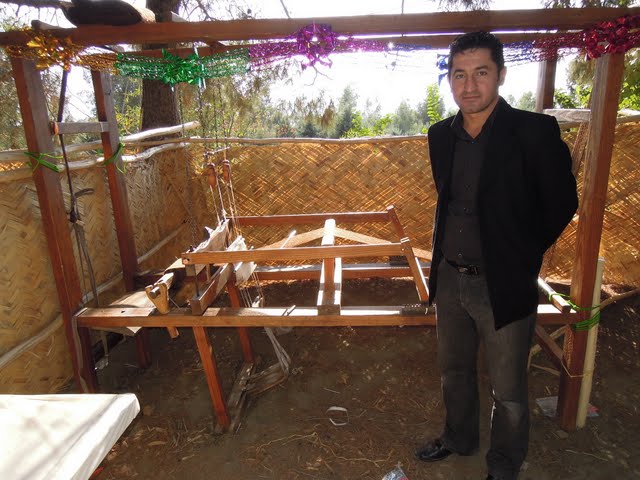
Then, a week later I was invited to visit an agricultural exhibition. Most of the exhibitions were of honey, but there was an example of salmon fishery, grains and fertilizers and in one stand a loom was set up with goats hair to weave the traditional fabric for men's suits. The cloth is around 6-7 inches wide and these strips are sewen together to create very traditional suits. He said that they cost $1,200 to buy as they are so labour intensive.
Finally, in a mountain village, Sunneh, that has experienced shelling this summer and fall, I saw an example of a student's handwork. This is an example of the kind of embroidery that has been done in the past. May this kind of learning continue.
PS. To my sewing friends. I will be making a bag for Sharaban to give her on my next trip. However, I would also like to bring her some sort of sewing item that she would be not able to get here. This would have to be something that would continue to be useable (eg. not a cutter and mat as she would not be able to get new blades here.) Any ideas?