Pages

Monday, April 15, 2013

Come Join in the dance- Part 3- Iraqi Kurdistan

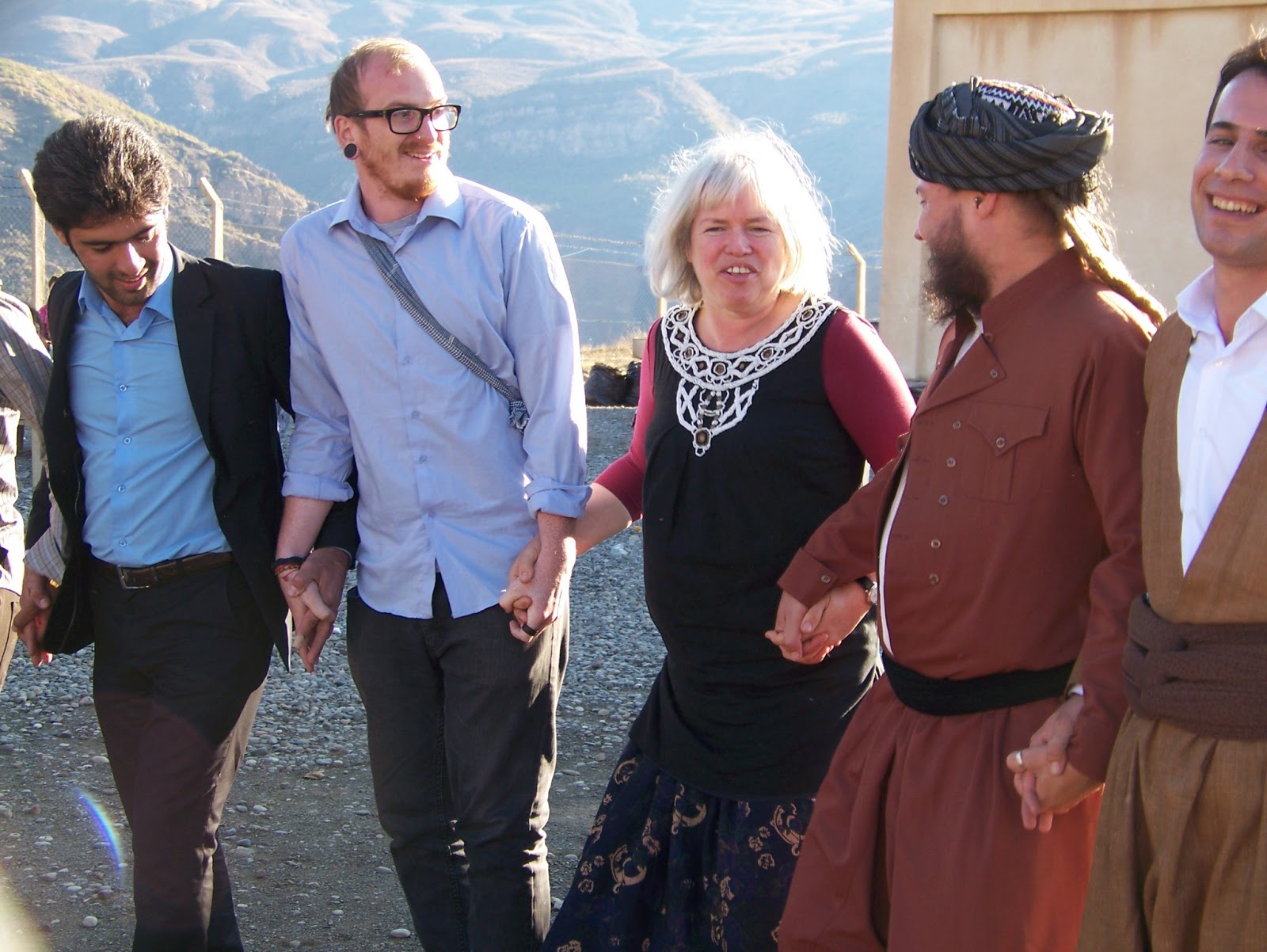
In the noon break of an Idle No More conference I joined a small round dance led by a women's drumming group. As the dancers clasped hands and formed a semi-circle, our legs moved in rhythm and our arms kept the beat. As I joined my friends in the dance I looked around and it seemed very familiar. The formation, the legs and feet, the hands clasped and the arms beating took me to the mountains of Iraqi Kurdistan. Only the music was different.

Dancing  is an integral part of the culture of the Kurds. Small groups or large groups can break into spontaneous movement- in the forest, in a meadow, on the street or even sometimes on the bus.  At the big Spring/New Year celebration, Naw Roz, family groups picnicking throughout the countryside bring loudspeakers and electronic players.These provide the beat and music. Then the  generations of friends and family  join hands in a semi circle, which can extend to a full circle if there are enough people. The feet move sideways around the circle while the arms and shoulders move vigorously to the beat. Occasionally, one has the privilege of having a live group playing drums and cuzela  (a nasally oboe type of wind instrument).

 Weddings are not complete without huge speaker systems that blast singers such as  Aziz Waysi, a very popular singer, and the circles of moving shoulders and feet. Below is a great video that shows village life along with an example of his music.
Our team was invited to celebrate the wedding of a son of one of our partners. The Autumn day was still quite warm and the sky blue. The mountainous region called the "Quandil" rose high above the foothills. The wedding celebration was held outside, on the grounds of a rural football/soccer stadium. Women, including the groom's mother,  prepared food over propane fires in large vats. Then the young men served the rice, chicken, mutton and vegetables to the women and children who sat on rugs around a plastic tablecloth. The men and older boys ate  separately. However, once the mess was rolled up in the disposable tablecloths and cleared away, the loudspeakers were unloaded from a big truck. The men moved over to the area with the women. And the dancing began.


 This is a bit of footage that I took with my little Nikon. It is a little rustic but shows the beautiful "jili Kurdi" and the long sleeves tied behind the back of the women.
 
My team mate who was brought up in the Christian faith said that his experience was turned around. There men and women were able to eat together and talk together but dancing was not allowed. Here men and women  must eat and talk separately, but when it comes to dancing they are welcome to join hands and dance side by side.

My Kurdish dancing experience mirrors the welcome that I have experienced in all my interactions with Kurdish people. They seem excited and  a little amused  that we desire to join into their cultural traditions, whether that is eating Kurdish food, sleeping on mats on their floors or joining their family in dance. But they say beker bate..welcome, welcome. ["You may be a  little strange looking and you don't know how to dance very well,"] But welcome, please come and join us..


I don't have any video footage of me joining the dance, but here are a couple of still photos.(Rosemary Milazzo)

Sunday, March 31, 2013

Come Join in the Dance- Part 2- Canada

I was born, the descendant of Irish/English immigrants, in Whitehorse, Yukon in 1960 and moved 6 months later. Then in 1966 my family  returned to the  north, to live in Watson Lake, Yukon.  My father was the Baptist Church minister in Watson Lake and in the Kaska First Nations reserve at Upper Liard. I have some faint memories of that time: a photo of us standing by a butchered moose that was being shared with our family, visiting families on the reserve, attending a school with white and indigenous children and the cold. I  have distinct memories of -60 F which translates to -51 C. We bundled up and went to school anyway. I don't have any memories of pow wows, round dances or drums. I am not sure why.
 
For my readers who are not in Canada here is a map. The Yukon is in the far left at the top. Whitehorse and Watson Lake are marked.
 
This is the church in Watson Lake. We lived behind it in a little house.
Me, sister Jane and brother David in front of our house.
 
 I was pretty proud of my beginnings in the Yukon. Not many people can lay claim to being a "sourdough" [a person who has lived at least one cycle of 4 seasons in the Yukon]. I  also thought that I knew quite a bit about the First Nations people.
 
I married and had two children and then in 2002 we moved to London, UK for seven years. We returned to Canada to live in Winnipeg, the city which is home to the largest urban indigenous population in Canada. I was not happy with my reaction as I walked the streets in the centre of the city. I now was fearful , apprehensive and not comforable at all. I challenged myself to spend time learning. Learning about my indigenous neighbours: about their beliefs, culture and situation.
 
Soon after my return Winnipeg was the site for the first event of the Truth and Reconciliation Commission.[ Over 130 residential schools were located across Canada from 1870's to 1996. These government-funded, church-run schools were set up to eliminate parental involvement in the intellectual, cultural, and spiritual development of Aboriginal children. The Truth and Reconciliation Commission of Canada has a mandate to learn the truth about what happened in the residential schools and to inform all Canadians about what happened in the schools.] My daughter and I went down to " The Forks". This is a historical site  that has been the meeting place of Aboriginal groups for thousands of years. In June 2010 it was the scene of tents and tipis, many indigenous people and many non-indigenous people as well.
 
That day I learned so much more than I imagined. I saw a map of residential schools in the Yukon and discovered that I had visited one as a child. I read records from schools across Canada and found that my new Mennonite denomination had a part to play. I sat and listened to a public story-telling circle as 20 people poured out their stories of grief and I heard the voices of heart-broken children coming from the bodies of grown adults. I wept, while feeling shame that me, a white woman, was so
distraught. I felt comfort as a First Nations woman came and offered me a smudge of sage smoke and to sit with me. On those days the rain poured down and many people expressed that it was a symbol of the grief and trauma that was being voiced, some for the first time.
 
On the last day of the event a Pow Wow was planned. This  is a time of dance and competition where  Aboriginal culture is celebrated. The sun finally shone and people gathered to watch and to participate. Many watchers  pointed  with awe at a huge eagle flying over the open field while an elder opened with a prayer.This was a very important sign for the event.  The Grand Entry was marvelous with beautiful regalia (traditional ceremonial clothing) and people of all ages joining together to celebrate.


At a pow wow various dances are announced, such as " all men in regalia can particpate in this dance", or "this one is for the children". When the leader said, "this dance is for everyone- you don't have to be in regalia", I assumed that meant it was for all indigenous people, whether or not they were dressed in finery or not. But he kept repeating it, urging others to join. I looked around. Surely, he did not mean anyone such as me. I did not want to do anything wrong- to intrude in a way that was not appropriate. But they kept announcing and urging, I looked over at some non-indigenous friends and they were getting  out of their lawn chairs and lining up to join the dance. I took the chance. It seemed that I was being invited too. The drum beat captured my heart and body and I entered into the dance.


Thursday, March 21, 2013

10 years past the London's 1,000,000+ person antiwar march

I have been reading a lot about  the Iraq War this week as it began 10 years ago this month. Tim N from CPT has put together links to things written by CPTers in Iraq over the past decade at http://cpt.org/cptnet/2013/03/19/iraq-ten-years-lamentation-partnering-and-action. And I was interviewed for  War News Radio for Swarthmore College (Pennsylvania). Fortunately they were also able to interview team mates Michelle, Peggy and Mohammed, because my knowledge of CPT and the people they worked with  10 years ago was very weak.   The section about  CPT in the show entitled "Ten Years Since Iraq"  starts around 1830  at http://warnewsradio.org/ . (There are a couple of mistakes in the show- CPT does not have 6 projects right now, only four, and we wish that she had not taken away from Mohammed's experience by saying that CPT was there to back him up in his vigil and thus segueing to CPT's work).

But this has brought back memories of living in London, UK in the time of the huge push from the people before the war started. I had not really had much experience with marches and demonstrations. But when we moved to London in Spring 2002, we came to a tiny little Mennonite church (Wood Green Mennonite) which was very active in such things.
I spent about an hour looking in friend's FB for photos of the 2003 demonstration but I could only find this one of Wood Green church at a local Wood Green demo. I created the banner to replace an old orange one.
 
My first experience was in November 2002 when the UK began to really resist what Blair was heading toward. Our family joined Bernhard Misrahi and family down in central London. Bernhard was a Jewish man who worshiped at a Mennonite church, was part of the Socialist movement, was a stanch compaigner for the Palestinian people and was heading into this march in a wheelchair. He was dying of terminal cancer and knew that this was to be his last march, so he wanted to be with both his Mennonite community and his Jewish Socialist community. However the police had contained us waiting for things to be set up properly and these two groups had been seperated. So my main memory of that march was racing behind Bernhard's chair pushed by his son Adam, through the thousands of people, trying to find the others in order to fulfill Bernhard's wish. We did find them, thanks to the marvelous invention of mobile phones. Bernhard died in January 2003, not long before the 1,000,000+ march that I am sure he would have loved to have been at.

On 15 February Wood Green Mennonite joined in what is alledged to have been the largest anti-war march ever on London streets. Wikipedia writes," The weather, on the day of the protest was grey and cold, but reports noted that people remained "in high spirits" as London became gridlocked and protesters were stuck for hours at Gower Street and Embankment. Hundreds of coaches brought protesters from 250 towns and cities across the UK, with around 100 coaches coming from Wales alone. Many commentators noted the diversity of those attending the march. Euan Ferguson noted in The Observer[37] that:
[As well as the] usual suspects - CND, Socialist Workers Party, the anarchists … There were nuns. Toddlers. Women barristers. The Eton George Orwell Society. Archaeologists Against War. Walthamstow Catholic Church, the Swaffham Women's Choir and Notts County Supporters Say Make Love Not War (And a Home Win against Bristol would be Nice). They won 2-0, by the way. One group of SWP stalwarts were joined, for the first march in any of their histories, by their mothers. There were country folk and lecturers, dentists and poulterers, a hairdresser from Cardiff and a poet from Cheltenham."
 
That is something I certainly remember, the long, long waits and the tiny baby steps because of the crush of the people. But it was exhilerating, as well as extremely tiring for the body, to be among so many diverse people saying, "NO, not in our name. " One vivid memory is walking by the theatre where the musical, "Les Miserables" was playing. It was intermission and the actors in costume were joining us by hanging out of the windows of their dressing rooms and waving the flags of the June Rebellion 1815 in Paris. That revolt ended in 93 dead, mostly from the "rebels". Our march in 2003  was very peaceful, but the war that would ensue very shortly would have so much bloodshed.

That evening we waited to see what the news said about the day. It was so dishearening and disgusting and enfuriating to hear Blair say, (my paraphrase), "I am so glad to be part of a country where people have the freedom to march the streets to speak out what they believe. However, despite so many of you coming out to tell me your opinion , I am declaring that we are still going to war".

It felt like he had taken a long, long pin and punctured a large balloon again and again. A few weeks later, after the war had started,  our small community attended a very small, local demonstration down the hill in Crouch End. People kept coming up to us and saying, "what's the use. I was there on 15 February, but Blair did not listen. We are in Iraq now. Our protest did not work."


It was hard to live in community as Canadians with dear friends from USA and Britian. Our country had listened to the massive outpouring of dismay and decided not to join in the move to invade. But in spite of our relief at that we needed to grieve along with our housemates the arrogance, disregard and duplicity of their governments.


Today I read some news reports from 15 February, 2013 remembering the demo of 10 years ago.  They said that the response from Blair to the outpouring of resistance had various results. Some gave up in disillusionment, but many (including myself) became much stronger activists. I believe it was another step in my life towards where I am today.


Tuesday, March 19, 2013

Loving my dancing shoes

OK. I have not done part 2 or 3 yet. But here is a quick post before I head to the plane to Toronto, Frankfurt, Istanbul and then Sulaimani.

In September 2012 I received such a lovely gift from two friends, Lukasz and Ramyar. They had both been in Colombia at the same time and spent a day heading to the market and choosing from the many, many unique shoes, a pair of mola shoes as a gift for me. It was all the more miraculous because they are so beautiful and they fit me!!

For those who don't know, a mola is a wonderful art form. E-how.com describes it as, "Kuna tribeswomen living in Columbia and Panama use mola applique to create intricate textile designs that feature brightly color fabrics and bold geometric images. Mola applique is a form of reverse applique that incorporates three or more layers of fabric.

 
This is a small section of an astoundingly amazing mola," The Peoples of the World" (by Fumiko Nakayami),  hanging  in St. Ethelburga's Centre for Reconciliation and Peace in London, UK. The whole thing is 4 metres and 2 metres and contains 40 panels. 

The molas can be very large to very small, as the shoes are. And every pair of shoes is unique. A number of people have thought that they are painted, but not so. Every colour is hand stitched.

Now the funny thing is that I was carrying them home in my suitcase and as I sat in the Frankfurt airport I looked over and saw a beautiful woman. As I glanced at her I was drawn to her feet because there was another pair of Colombian mola shoes. I had to go and talk to her. I said, "Are your shoes from Colombia?". She grabbed my arm and said excitedly "you know where they come from!!!". She told me that she was from Kenya and had known about the molas. So when a friend had visited the country she asked her to bring her back a pair. It was a very nice connection to make.


I thought that I had taken a photo of the rest of her body too, but it must not have turned out.
 

So my shoes are very comfortable and they have broken in very nicely (when I told my poor team mate that he looked at me in horror, "they are broken already?". I assured him that "broken-in" had totally different meaning and was actually a very good thing).

I am not taking them back to Iraqi Kurdistan because the dust of spring and summer will really dim the vibrant colours. But they will be waiting for me in Winnipeg- my new dancing shoes.

Monday, March 4, 2013

Guest post: Iraqi Kurdistan: Nonviolence 102

( Dancing part 2 and 3 are still to come, but here is a reflection by team mate Annika. The team has done 4 of these workshops so far in high schools, and plan a few more before school closes this year. It is very exciting to me as we had dreams of doing this last year. Now it has really happened with great evaluations from the students).


IRAQI KURDISTAN: Nonviolence 101
by Annika Spalde
The classroom was cold and crowded with old and squeaky benches. We began moving them aside a bit, to make room for the exercises. A group of girls came in and eagerly sat in the front benches. "Oh, there's no electricity! We can't show them the film clips that we've prepared!"
"Some of the students need to take a bus at twelve o'clock, so there's only fifty minutes for the workshop," said one of the teachers. Hmm. We had asked for an hour and a half…. More and more students come in. We had agreed on forty but I think that there were sixty or more. Okay, we say to one another, let's do the best we can under the circumstances.


After a short introduction of us and CPT, I start with the first exercise, the spectrum. "Those of you who believe that there is a lot of violence in your society, you put yourselves on this end of the line. If you think there is not a lot of violence in society, you go to the other end." They come up, and most of them go to the "a lot of violence" end. "Why did you put yourself here?" I ask the guy standing on the far end. "Yes there is a lot of violence," he responds, "for example in the homes, against women." Another says, "Some people have the possibility to go to fancy hospitals abroad if they need care, most of us can't do that." A third student says: "There is also psychological violence, like when someone speaks in a degrading way to another." They give several more examples. I'm surprised at how quickly they think of different kinds of violence, and how eager the children are to share their thoughts.
Lukasz takes over the facilitation, "So, how are we, as a society, going to move from this side to the other side of the spectrum? There are two common reactions to violence. One is to respond with violence, the other to run away, or just look the other way. Nonviolence is a third alternative. It means to fight for justice and peace without the use of violence." The students had ideas about how to do this. "We need to learn more ourselves. We need to educate people about nonviolence." Mohammed and I then shared briefly about Gandhi, the principles of nonviolence, and some nonviolent methods. In the beginning the atmosphere was kind of messy, but by now everyone was listening attentively.
Afterwards when Mohammed read aloud from the students' written evaluations, I felt happy and grateful. "It should have been longer!" one student wrote. "I have learnt that violence only gives rise to more violence," said another. "You forgot to mention sexual violence." "I want this kind of workshop every year." Maybe we have sown a few seeds, even if this time the workshop was so short and a bit chaotic.


Wednesday, February 13, 2013

Come join in the dance, Part 1-Bosnia

In my faith community of origin dancing was one of the things that was not exactly allowed. I never did quite figure out what the problem was, but I knew that I could not attend the school dances with my family or church's blessing. That is not to say that I did not go , but that is a story beyond the scope of this post. Although I am now an adult and have made my own discernment about the issue, this "training" does cause me to have the misgiving and feeling that my body does not want to dance. I no longer have the prohibition, but getting the legs, arms and trunk moving takes a lot of concentration and letting go.

However, I have three dancing stories. On these 3 times I have had the privilege of being invited by people outside of my culture, to join in their dance.

The first time took place on my first real trip outside of my comfort zone. In March 1994 I joined a group of young Germans to live in a Bosnian refugee camp in Split, Croatia for 3 weeks.  This was while the Balkan War was still taking place. The German  Mennonite Peace Committee (DMFK) organised groups to go to various camps with the mandate to play with the children. At that time schooling was not provided for the young  refugees and the adults were often so traumatised that they were unable to provide entertainment for the children, so a lot of time they were left without much to do. We loaded up a van with footballs,  craft supplies and games and set off on the two day journey.


We experienced extreme hospitality. Here they had made two large pans of "pita bosna" a traditional food made of very thinly rolled dough layered with onions and potatoes just for us.

The women did not understand how I came to come to their camp. It was so unusual that my husband would let me come. One day they delighted in dressing me up in the traditional loose trousers and head covering.

 
 I met this woman on the second day of our stay. It was also the day that she learned that her 21 year old son had been killed at the front. I spent a lot of time sitting with her.
 
TWO WOMEN
She-Bosnian Mother
 
I have lost a son
Far off in Bosnia land
I will never again see him
Touch him, rock him, hug him to my breast
Just 21 years -now gone.
I sit here-so helpless
Nothing I can do
But silently weep into my kerchief
He is gone.
 
Me- Short-term Volunteer
 
I see an old woman squatting on the floor
Her eyes slowly fill with tears
She has lost her son
Two days ago she heard the news
Just 21 years-short life
Now-shot-dead
My arms want to hug her, to cry with her
Is it acceptable to touch, to hug?
Three weeks I live with her-learning to sit still and touch.
Very little talking-I don't understand, she doesn't either
So we sit
Sometimes she cries into her kerchief
Sometimes she smiles
Together we sit---together 


Through the 3 weeks we spent a lot of time in the camp, Voljak. There were approximately 80 persons living there in the residential part of a cement factory. They were all from the same village which was near Teslić, Bosnia (north-central Bosnia Herzegovina). In the process of playing we grew to know the parents and other adults. We shared food and times of singing. One evening we sat together in a  room that held 12 bunk beds. Some of these held 4 people for the night. People were relaxed and comfortable. Through our young translators they told us stories of how life was before the conflict started.

They shared a video that showed a large dance festival that was held annually in their village. People of all the heritages came to dance together. They were obviously disturbed as they told of how these connections and relationships were severed as the war began. They had not danced at all since leaving their homes. They had never danced together in the refugee camp.We began to gently explore the possibility of learning a Bosnian dance.
 
One of the bunk beds being used as a couch.
 
THE DANCE
 

Us: We are interested in learning a Bosnian dance.
Them: Oh yes, some day.
Them: Oh yes, but we can't do it tonight. Others are sleeping.
Them: Oh yes, but he has no one to dance with.
Them: Oh yes, but the music player is not here.
Us: OK, but we really want to learn a Bosnian dance
Them: Here is the music man
            Here is a woman
             Forget the people in the next room
             Let's dance!!

Arms on shoulders
Feet moving quickly, avoiding bed posts and coffee cups
Sweat, heavy breathing

Them: Come -- now you must dance

Slowly, then faster
Legs in and out
What a great feeling
We are dancing
They are dancing
For the first time since Bosnia.
We are dancing
Together.



Monday, February 4, 2013

Singing to an Unseen Audience


(Photo- Sandra Stevens)
 

Three days ago  I was a singer in a choir to an unseen audience. The stage was a sidewalk outside of a deportation centre in Chicago, Illinois. The audience was hidden safely behind large garage doors and blacked out glass in six vans. I wondered if the safety is for them, us, or the system that tries to hide the fact that 425,000 undocumented workers in the US are whisked out of the country every year. It does not matter if they act like good or bad people, they are sent away. The choir sang in somewhat croaking three part harmony- "Courage, migrant brother,/ you do not walk alone/ we will walk with you/ and sing your spirits home.”


The current CPT training group braved the bitter cold wind as they attended the weekly vigil at Broadview Detention Centre. Broadview is a detention center run by the Chicago office of the U.S. Immigration and Customs Enforcement (ICE). Every Tuesday and Friday the bus and vans are loaded with men and women who have been rounded up in raids on their homes or workplaces. Many of them leave behind loved ones. They ride in shackles on the bus to the airport to be flown to a land considered to be their homeland, but which many of them have never lived in. One of the delegates, Cory Lockhardt, wrote in her blog about her experience.  http://www.trulylovethyneighbor.com/2013/02/courage-migrant-brothers.html?spref=fb


As I experienced this action today I was taken back to my own training in July/August 2010 on a much warmer day. In my notes that I saved in my gmail drafts  I noted that we had met two of the nuns who had fought the system  to gain the opportunity to pray with the detainees before they were sent off to the airport. I wrote, “ I am so I shocked that in this "Christian nation"  they had to fight for two years to be able to pray for these people on the buses.” These nuns asked us to stay within the guidelines, to not plan surprise civil disobedience or some other resistance. For them the important goal was to make a weekly presence and to provide a small bit of psychological support for the men and women who were leaving their homes. We found out that early in the morning they were also allowed to visit any detainee who wished and gave out cards telling them where they could get physical help when they were unshackled and pushed out into the country on the other end.


 I entered one of those buses along with the young man who would become my son in law and another trainee, to pray with and for the persons there. We wanted them to have an image of someone who cared as a lasting picture of the USA. We could do nothing to change their situation at this time, but we could pray with them and let them know that someone knew of their grief and cared.


As we entered the bus and yelled through the plexi glass barrier (because the intercom did not work) introducing ourselves, the whole busload erupted into clapping . That felt so strange. They were thanking us for coming to say goodbye to them. As we spoke our names one man lifted up his handcuffed arms and pointed to the shackles around his waist and ankles and said, “They treat us like criminals. We are not criminals”. We told him that we knew this. Then we read a short statement that we had prepared and that was translated into Spanish by our team mate. We said the Lord’s Prayer together, joined by most of the people on the bus. Then we stepped down to the ground.


Next we were taken to a van that held 8 men being sent to some Central American countries.  Here we were separated only by a grating and we could speak in normal volumes. As I was introduced as being from Canada, a young man right next to me quietly asked, “What is Canada like?” Searching for the correct thing to say I answered, “Canada is good”. He said softly, “I wanted to go to Canada”. I almost lost my resolve to stay calm.  I could not say that Canada would treat him any better. He had shackles and handcuffs just because he had crossed an invisible line in the sand and tried to stay on the ‘wrong” side.


On that summer day in 2010, after the bus and van had driven away, Laurens and I stood with the rest of the vigil, arms around each other and silently weeping. This was not our country, but we knew that in Canada and the Netherlands such scenarios take place as well. I thought of the privilege I had of owning two passports that gave me such freedom to choose where I lived.


Three days ago, as I sang in the choir to the unseen audience, I heard a gentle clinking sound. I turned around to see a man exiting from a car carrying a large armload of chains and shackles. I imagined that he had been there when they released a group of people, and was bringing them back to the centre to put them onto some of the 1000 detainees in that building so they could be sent out.


The three trainees who were in the parking garage praying on this cold day told us that when the large bus sized garage door lifted they could hear our voices. That means that possibly some of the detainees beginning their journey could also. We sang the song over and over, despite voice fatigue and freezing toes, hoping that in some way it would send them on their way with a tiny bit of hope.