Pages

Friday, May 17, 2013

Peace is a woman and woman is peace

I am reposting a reflection I recently wrote for CPT Net and that we posted on our Iraqi Kurdistan team blog.

 http://cpt-iraqikurdistan.blogspot.com/2013/05/peace-is-woman-and-woman-is-peace.html

But I will also post it here for those who have not seen it in the other places. Like I said in my last post  it was an incredible day.

May 14, 2013

Peace is a woman and woman is peace.


"The LORD will guide you continually, giving you water when you are dry and restoring your strength. You will be like a well-watered garden, like an ever-flowing spring". Isaiah 58:11


The high mountain ridges, still covered in a blanket of snow showed the borderline of Iraq and Iran.  A tiny newborn goat with the umbilical cord still drying on its belly wandered around by our legs. The unceasing sound of the artesian spring gave background noise to our conversation.


There we were, sitting around a table under bright green grape leaves and infant grape clusters that protected us from the hot sun.  Unusually, the women outnumbered the men. However, even more unusual was that the first question came from a woman to me. “I am asking you because you are a woman’, she said. “Violence against women happens all over the world. How do you think that we can change that?” I admitted that considering making changes to such a huge issue was beyond me.  I thought that we must work at a level of helping one man to see things differently, or to empower one woman at a time. She agreed.


I marvelled that I was able to be here on this awesome spring day, having a conversation with a Kurdish woman who had lived and fought in these mountains for 21 years.  I knew that our ideology and methods were quite different, but I felt a kinship with her. Her organisation strives to provide equal opportunity for all, no matter which gender. She had been trained extensively right alongside the men.   She was secure in her beliefs that the way to start making a difference in the world was working on attitudes toward and treatment of women. “We should all should work together, young and old women. We need to include more women in these reforms because the peace is a woman and woman is peace.”

We spoke of the hope for the end of the conflict, when the peace agreement with Turkey really materializes. Her dream was to someday go beyond the borders of Iraq, to speak to people of other nations, to train women and to share her knowledge and experience. When we asked her how she saw peace, she gestured and looked around at the plot of land, the grape vines, the spring and the goat. She said, “When everyone in the world has this.”
The conversation was far too short, but the sun was sinking lower in the sky and we had a long drive over a rocky road ahead of us. As we hugged and kissed goodbye she commented,” You should be a leader in a women’s organisation”.  I received her affirmation and treasured it.

Wednesday, May 15, 2013

Basta, beautiful Basta.

A week ago I had the privilege of going to a place where few non  Kurdish people have been. There is a tiny village named Basta that is in the foothills of the Quandil mountains. From our friend, Bapier's house you can see the peaks that are the border of Iran and Iraq.


Bapier has  invited the team to visit many times. But unfortunately, the village is past a line  that the Iraqi Kurdistan security forces are reluctant to let us cross. We are not sure why they have a problem. Maybe they think that we will be in danger? This time Lukasz and I had friends with us who knew who to phone. So, after a number of calls, including the mayor of  a larger town, they let us through. But they did keep our residency cards to ensure that we would not flee over the mountains to Iran (I guess).

The day showed the glory of spring.

The highest mountains still had a covering of snow, but we could feel the heat of the sun beginning to exhibit its strength and the fields were green, green, green.  Bapir was so excited that we were finally able to come to his village. invited us into his simple house and we sat on the carpet in the sitting room. His older daughters stayed in the kitchen, but the middle ones came and served the tea.


 The little boys wandered in and out. There was a mild problem when I shared some little plastic dinosaurs with them. The "roaring of the animals" caused Bapir to gently push them out of the door with a command to play elsewhere. It worked for a few minutes, until they came back to see what else of interest the visitors might have.
Two of Bapir's sons and Angel (our friend)'s brother in law looking at the marvels of games on a mobile phone.

We asked Bapir how he felt about the recent cease fire between the opposition forces and Turkey. If this really happens it will have a massive positive effect on this village, like many others along the border regions. CPT has supported the villagers of Basta since 2006. Every summer he village has emptied  as the shelling and bombing season started. They evacuated to  an Internally Displaced Persons tent camp further down the mountain beside a rushing mountain stream. Summer 2012 was the first growng season in 7 years that they were able to stay beside their animals and gardens. It was was also the year that the Kurdish Regional government finally provided more permanent dwellings for the camp that have remained empty. Bapir dreams of the day when his family will be able to be secure enough to stay in the village with him.


Bapir and me and his little son.
 
 
This is a brand new mosque that the villagers have built. It is almost finished and will provide a place for prayer.


They served us  a lovely meal of chicken, rice and a soup called quirew that is made out of yogurt and spices. We have been told that this is a very special soup made for guests.

Then we went out for a tour of Basta.
 

This is the second house we visited (and had our 4th cup of tea). The man in the dark brown Kurdish suit is the sheikh of the village-another leader.
 
 
A reminder of a scarier day in the village. Schrapnel from shelling came through the window into the house.
 
 
Bapir's daughter climbed the kezhwan tree to get the green fruit for us. They were a little sour and made the mouth pucker up. I ate a few for the experience and then gave the rest of my bunch to my little friend.
My little friends. The one in the yellow shirt desperately wanted to stay with me, even when I had the use the toilet. It was a 3 sided enclosure without a door. I tried to convince him it was a bad idea, but it took his sister to hold him back so I had a vestige of privacy!


On another visit Bapir had gifted Lukasz with a traditional men's hat. So L. gave him a CPT cap. I guess this daughter decided that it was perfect for her.
 
At the last house we visited we were offered "mast-aw" (yogurt mixed with water). A refreshing change to tea.
In the days before Sadaam Hussein's "Anfal"- his attempt to eradicate the Kurds, Basta had 75 houses. Now there are 21.
 
I was curious. I told the young people present at the second house that often in Canada the young adults can not wait to get out of the villages and to go to the city. I asked how they felt about being in the village. They all replied that this was the place they loved. They hated the city and wanted to live in the mountains despite the remoteness. Many of them work as shepherds or caring for other livestock.
 
The villagers still are not secure that peace will come. They are waiting to see what how the neighbouring countries will handle the agreement and whether the bombing and shelling will be finished for ever.


Tuesday, April 16, 2013

My husband has 1/2 a wife.....

Today was one of those days that makes me love my work. The team had decided to visit one of our contacts who is a mullah/imam/leader of a Muslim mosque to pay our respects. His brother had died a month ago and it is the proper thing to do. Unfortunately, when the time came one of my team mates had spots all over his body from a silly virus and the other had stomach problems. So I went with Mohammed to the house attached to the little mosque.

We were greeted by the mullah and his two tiny daughters. We met one woman and then his wife. After we were settled with glasses of water and cushions to lean against, Mohammed expressed our sadness at the loss of his brother. Then the cake with  tea and bowls of watermelon came out of the kitchen . The two women sat down against the wall on the other side of the room to listen. The conversation went back and forth: Kurdish, English, English, Kurdish. Then M. looked at me and said, " this woman is his second wife. They were married six months ago". I could tell they all were looking at me for my reaction. I smiled and put my hand over my heart. They smiled back.

We talked about fundraising; how CPT gets its money. Does it get government funding for rent or food? M. said  that we did not and then went on to explain how individuals give money to CPT for our work. I asked M. to tell him about my fundraising suppers and they were thrilled by that idea. They asked what kinds of Kurdish food I had prepared and were suitably impressed. However, they thought that if they tried such a thing here- make a meal and then tell people they had to pay for it- they would never come back!

After more conversation I decided to be bold. I asked if I could ask the women some questions. They agreed readily. So I told them about how I had been the daughter of a Christian pastor (mullah) and sometimes my mother found it hard to be the wife of a pastor. I asked them how it was for them and if they found that the community expected them to be better than most women. They both agreed that it was good to be the mullah's wives. They did feel higher expectations, but  explained that they knew he was in that position when they agreed to marry him. They all played and cared for the little girls while they talked.

I have never really had occasion to think about polygamy. But it did not matter at this point. We were talking and sharing our stories together. Mulah asked me about my husband and children. I explained that now my marriage was unusual in my culture, with me being here for 1/2 the year. He listened well to my story of how we came to the agreement that I was to do this work here in Iraqi Kurdistan.

But, I thought to myself, "hmm. right now Vic (my husband) has 1/2 a  wife and right now the mullah has 2x ."

Before we left, I had agreed to come back to their house to learn how to make Kurdish bread and cake from the wives. The idea is quite exciting, but so stretching to think of spending a whole day with my limited Kurdish and their  lack of English. But I promised to bring my dictionary and I think we will do well.

Monday, April 15, 2013

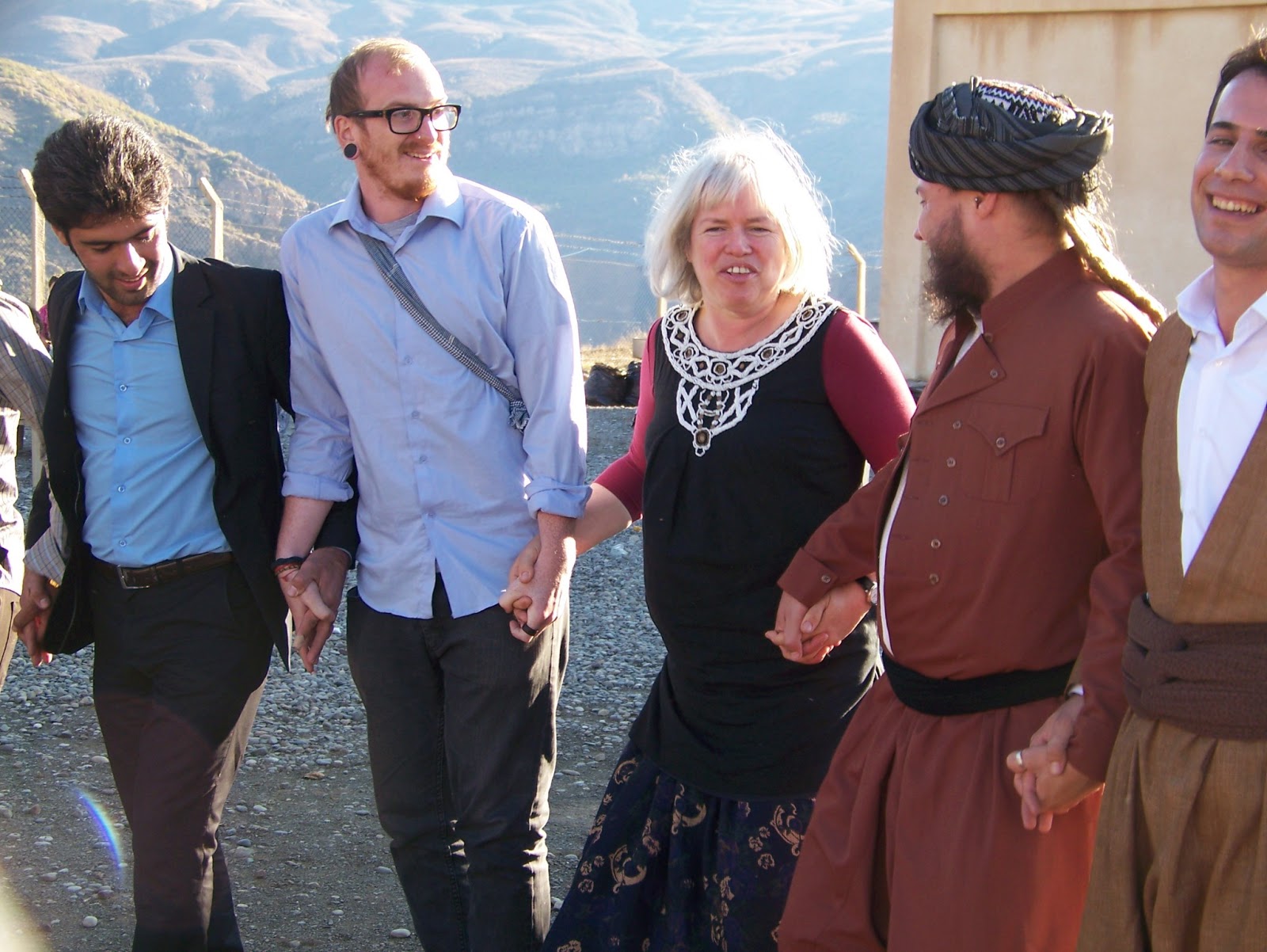
Come Join in the dance- Part 3- Iraqi Kurdistan

In the noon break of an Idle No More conference I joined a small round dance led by a women's drumming group. As the dancers clasped hands and formed a semi-circle, our legs moved in rhythm and our arms kept the beat. As I joined my friends in the dance I looked around and it seemed very familiar. The formation, the legs and feet, the hands clasped and the arms beating took me to the mountains of Iraqi Kurdistan. Only the music was different.

Dancing  is an integral part of the culture of the Kurds. Small groups or large groups can break into spontaneous movement- in the forest, in a meadow, on the street or even sometimes on the bus.  At the big Spring/New Year celebration, Naw Roz, family groups picnicking throughout the countryside bring loudspeakers and electronic players.These provide the beat and music. Then the  generations of friends and family  join hands in a semi circle, which can extend to a full circle if there are enough people. The feet move sideways around the circle while the arms and shoulders move vigorously to the beat. Occasionally, one has the privilege of having a live group playing drums and cuzela  (a nasally oboe type of wind instrument).

 Weddings are not complete without huge speaker systems that blast singers such as  Aziz Waysi, a very popular singer, and the circles of moving shoulders and feet. Below is a great video that shows village life along with an example of his music.
Our team was invited to celebrate the wedding of a son of one of our partners. The Autumn day was still quite warm and the sky blue. The mountainous region called the "Quandil" rose high above the foothills. The wedding celebration was held outside, on the grounds of a rural football/soccer stadium. Women, including the groom's mother,  prepared food over propane fires in large vats. Then the young men served the rice, chicken, mutton and vegetables to the women and children who sat on rugs around a plastic tablecloth. The men and older boys ate  separately. However, once the mess was rolled up in the disposable tablecloths and cleared away, the loudspeakers were unloaded from a big truck. The men moved over to the area with the women. And the dancing began.


 This is a bit of footage that I took with my little Nikon. It is a little rustic but shows the beautiful "jili Kurdi" and the long sleeves tied behind the back of the women.
 
My team mate who was brought up in the Christian faith said that his experience was turned around. There men and women were able to eat together and talk together but dancing was not allowed. Here men and women  must eat and talk separately, but when it comes to dancing they are welcome to join hands and dance side by side.

My Kurdish dancing experience mirrors the welcome that I have experienced in all my interactions with Kurdish people. They seem excited and  a little amused  that we desire to join into their cultural traditions, whether that is eating Kurdish food, sleeping on mats on their floors or joining their family in dance. But they say beker bate..welcome, welcome. ["You may be a  little strange looking and you don't know how to dance very well,"] But welcome, please come and join us..


I don't have any video footage of me joining the dance, but here are a couple of still photos.(Rosemary Milazzo)

Sunday, March 31, 2013

Come Join in the Dance- Part 2- Canada

I was born, the descendant of Irish/English immigrants, in Whitehorse, Yukon in 1960 and moved 6 months later. Then in 1966 my family  returned to the  north, to live in Watson Lake, Yukon.  My father was the Baptist Church minister in Watson Lake and in the Kaska First Nations reserve at Upper Liard. I have some faint memories of that time: a photo of us standing by a butchered moose that was being shared with our family, visiting families on the reserve, attending a school with white and indigenous children and the cold. I  have distinct memories of -60 F which translates to -51 C. We bundled up and went to school anyway. I don't have any memories of pow wows, round dances or drums. I am not sure why.
 
For my readers who are not in Canada here is a map. The Yukon is in the far left at the top. Whitehorse and Watson Lake are marked.
 
This is the church in Watson Lake. We lived behind it in a little house.
Me, sister Jane and brother David in front of our house.
 
 I was pretty proud of my beginnings in the Yukon. Not many people can lay claim to being a "sourdough" [a person who has lived at least one cycle of 4 seasons in the Yukon]. I  also thought that I knew quite a bit about the First Nations people.
 
I married and had two children and then in 2002 we moved to London, UK for seven years. We returned to Canada to live in Winnipeg, the city which is home to the largest urban indigenous population in Canada. I was not happy with my reaction as I walked the streets in the centre of the city. I now was fearful , apprehensive and not comforable at all. I challenged myself to spend time learning. Learning about my indigenous neighbours: about their beliefs, culture and situation.
 
Soon after my return Winnipeg was the site for the first event of the Truth and Reconciliation Commission.[ Over 130 residential schools were located across Canada from 1870's to 1996. These government-funded, church-run schools were set up to eliminate parental involvement in the intellectual, cultural, and spiritual development of Aboriginal children. The Truth and Reconciliation Commission of Canada has a mandate to learn the truth about what happened in the residential schools and to inform all Canadians about what happened in the schools.] My daughter and I went down to " The Forks". This is a historical site  that has been the meeting place of Aboriginal groups for thousands of years. In June 2010 it was the scene of tents and tipis, many indigenous people and many non-indigenous people as well.
 
That day I learned so much more than I imagined. I saw a map of residential schools in the Yukon and discovered that I had visited one as a child. I read records from schools across Canada and found that my new Mennonite denomination had a part to play. I sat and listened to a public story-telling circle as 20 people poured out their stories of grief and I heard the voices of heart-broken children coming from the bodies of grown adults. I wept, while feeling shame that me, a white woman, was so
distraught. I felt comfort as a First Nations woman came and offered me a smudge of sage smoke and to sit with me. On those days the rain poured down and many people expressed that it was a symbol of the grief and trauma that was being voiced, some for the first time.
 
On the last day of the event a Pow Wow was planned. This  is a time of dance and competition where  Aboriginal culture is celebrated. The sun finally shone and people gathered to watch and to participate. Many watchers  pointed  with awe at a huge eagle flying over the open field while an elder opened with a prayer.This was a very important sign for the event.  The Grand Entry was marvelous with beautiful regalia (traditional ceremonial clothing) and people of all ages joining together to celebrate.


At a pow wow various dances are announced, such as " all men in regalia can particpate in this dance", or "this one is for the children". When the leader said, "this dance is for everyone- you don't have to be in regalia", I assumed that meant it was for all indigenous people, whether or not they were dressed in finery or not. But he kept repeating it, urging others to join. I looked around. Surely, he did not mean anyone such as me. I did not want to do anything wrong- to intrude in a way that was not appropriate. But they kept announcing and urging, I looked over at some non-indigenous friends and they were getting  out of their lawn chairs and lining up to join the dance. I took the chance. It seemed that I was being invited too. The drum beat captured my heart and body and I entered into the dance.


Thursday, March 21, 2013

10 years past the London's 1,000,000+ person antiwar march

I have been reading a lot about  the Iraq War this week as it began 10 years ago this month. Tim N from CPT has put together links to things written by CPTers in Iraq over the past decade at http://cpt.org/cptnet/2013/03/19/iraq-ten-years-lamentation-partnering-and-action. And I was interviewed for  War News Radio for Swarthmore College (Pennsylvania). Fortunately they were also able to interview team mates Michelle, Peggy and Mohammed, because my knowledge of CPT and the people they worked with  10 years ago was very weak.   The section about  CPT in the show entitled "Ten Years Since Iraq"  starts around 1830  at http://warnewsradio.org/ . (There are a couple of mistakes in the show- CPT does not have 6 projects right now, only four, and we wish that she had not taken away from Mohammed's experience by saying that CPT was there to back him up in his vigil and thus segueing to CPT's work).

But this has brought back memories of living in London, UK in the time of the huge push from the people before the war started. I had not really had much experience with marches and demonstrations. But when we moved to London in Spring 2002, we came to a tiny little Mennonite church (Wood Green Mennonite) which was very active in such things.
I spent about an hour looking in friend's FB for photos of the 2003 demonstration but I could only find this one of Wood Green church at a local Wood Green demo. I created the banner to replace an old orange one.
 
My first experience was in November 2002 when the UK began to really resist what Blair was heading toward. Our family joined Bernhard Misrahi and family down in central London. Bernhard was a Jewish man who worshiped at a Mennonite church, was part of the Socialist movement, was a stanch compaigner for the Palestinian people and was heading into this march in a wheelchair. He was dying of terminal cancer and knew that this was to be his last march, so he wanted to be with both his Mennonite community and his Jewish Socialist community. However the police had contained us waiting for things to be set up properly and these two groups had been seperated. So my main memory of that march was racing behind Bernhard's chair pushed by his son Adam, through the thousands of people, trying to find the others in order to fulfill Bernhard's wish. We did find them, thanks to the marvelous invention of mobile phones. Bernhard died in January 2003, not long before the 1,000,000+ march that I am sure he would have loved to have been at.

On 15 February Wood Green Mennonite joined in what is alledged to have been the largest anti-war march ever on London streets. Wikipedia writes," The weather, on the day of the protest was grey and cold, but reports noted that people remained "in high spirits" as London became gridlocked and protesters were stuck for hours at Gower Street and Embankment. Hundreds of coaches brought protesters from 250 towns and cities across the UK, with around 100 coaches coming from Wales alone. Many commentators noted the diversity of those attending the march. Euan Ferguson noted in The Observer[37] that:
[As well as the] usual suspects - CND, Socialist Workers Party, the anarchists … There were nuns. Toddlers. Women barristers. The Eton George Orwell Society. Archaeologists Against War. Walthamstow Catholic Church, the Swaffham Women's Choir and Notts County Supporters Say Make Love Not War (And a Home Win against Bristol would be Nice). They won 2-0, by the way. One group of SWP stalwarts were joined, for the first march in any of their histories, by their mothers. There were country folk and lecturers, dentists and poulterers, a hairdresser from Cardiff and a poet from Cheltenham."
 
That is something I certainly remember, the long, long waits and the tiny baby steps because of the crush of the people. But it was exhilerating, as well as extremely tiring for the body, to be among so many diverse people saying, "NO, not in our name. " One vivid memory is walking by the theatre where the musical, "Les Miserables" was playing. It was intermission and the actors in costume were joining us by hanging out of the windows of their dressing rooms and waving the flags of the June Rebellion 1815 in Paris. That revolt ended in 93 dead, mostly from the "rebels". Our march in 2003  was very peaceful, but the war that would ensue very shortly would have so much bloodshed.

That evening we waited to see what the news said about the day. It was so dishearening and disgusting and enfuriating to hear Blair say, (my paraphrase), "I am so glad to be part of a country where people have the freedom to march the streets to speak out what they believe. However, despite so many of you coming out to tell me your opinion , I am declaring that we are still going to war".

It felt like he had taken a long, long pin and punctured a large balloon again and again. A few weeks later, after the war had started,  our small community attended a very small, local demonstration down the hill in Crouch End. People kept coming up to us and saying, "what's the use. I was there on 15 February, but Blair did not listen. We are in Iraq now. Our protest did not work."


It was hard to live in community as Canadians with dear friends from USA and Britian. Our country had listened to the massive outpouring of dismay and decided not to join in the move to invade. But in spite of our relief at that we needed to grieve along with our housemates the arrogance, disregard and duplicity of their governments.


Today I read some news reports from 15 February, 2013 remembering the demo of 10 years ago.  They said that the response from Blair to the outpouring of resistance had various results. Some gave up in disillusionment, but many (including myself) became much stronger activists. I believe it was another step in my life towards where I am today.


Tuesday, March 19, 2013

Loving my dancing shoes

OK. I have not done part 2 or 3 yet. But here is a quick post before I head to the plane to Toronto, Frankfurt, Istanbul and then Sulaimani.

In September 2012 I received such a lovely gift from two friends, Lukasz and Ramyar. They had both been in Colombia at the same time and spent a day heading to the market and choosing from the many, many unique shoes, a pair of mola shoes as a gift for me. It was all the more miraculous because they are so beautiful and they fit me!!

For those who don't know, a mola is a wonderful art form. E-how.com describes it as, "Kuna tribeswomen living in Columbia and Panama use mola applique to create intricate textile designs that feature brightly color fabrics and bold geometric images. Mola applique is a form of reverse applique that incorporates three or more layers of fabric.

 
This is a small section of an astoundingly amazing mola," The Peoples of the World" (by Fumiko Nakayami),  hanging  in St. Ethelburga's Centre for Reconciliation and Peace in London, UK. The whole thing is 4 metres and 2 metres and contains 40 panels. 

The molas can be very large to very small, as the shoes are. And every pair of shoes is unique. A number of people have thought that they are painted, but not so. Every colour is hand stitched.

Now the funny thing is that I was carrying them home in my suitcase and as I sat in the Frankfurt airport I looked over and saw a beautiful woman. As I glanced at her I was drawn to her feet because there was another pair of Colombian mola shoes. I had to go and talk to her. I said, "Are your shoes from Colombia?". She grabbed my arm and said excitedly "you know where they come from!!!". She told me that she was from Kenya and had known about the molas. So when a friend had visited the country she asked her to bring her back a pair. It was a very nice connection to make.


I thought that I had taken a photo of the rest of her body too, but it must not have turned out.
 

So my shoes are very comfortable and they have broken in very nicely (when I told my poor team mate that he looked at me in horror, "they are broken already?". I assured him that "broken-in" had totally different meaning and was actually a very good thing).

I am not taking them back to Iraqi Kurdistan because the dust of spring and summer will really dim the vibrant colours. But they will be waiting for me in Winnipeg- my new dancing shoes.