Pages

Showing posts with label Kurds. Show all posts

Thursday, February 4, 2016

A poem" The boats, the sea, the lives"

Yesterday morning our team joined together for our gathering/worship time. The internet had turned on after the night and so people were taking a quick look at their Face Book and emails. My team mate Mohammed showed me a photo of a teenage boy and a woman. I looked at him with a question on my face. He said, "he was my student". I said, "he drowned?" Mohammed's face told me that I was correct. Yad had been in his class two years ago. The impact of the deaths drew near to us.

Lukasz immediately changed the topic for his gathering. We sat in silence and drew and wrote out our feelings. Last week 28 Kurds died in the Aegean Sea, yesterday 103 were on the boat, including young Yad from Sulaimani. I wrote this poem as we sat together. 

The boats, the sea, the lives

Kurdistan, oh Kurdistan
How I hate to leave you
But how I long to leave you.
Political crisis, financial crisis
No electricity, no salaries, no school
There is no life, there is no hope
There is no future for my son.
We must leave

I heard about thousands drowning in the sea
Surely they were not prepared
Surely they paid the wrong smuggler
Surely they bought the fake life preservers
We will do better
We will stay in the boat and live

Today the son is a photo on Facebook
Yad- his fourteenth year was his last
There is no life, there is no hope
His body will return to Kurdistan.


Sunday, August 3, 2014

On the bus to Sagkeeng I looked up and saw a Kurdish man's hat...

A few weeks ago I and my CPT colleague, Peter Haresnape, were invited to join a day away to the First Nation community of Sagkeeng. The main participants of the trip were some of the members of a Genocide scholars conference being held in Winnipeg.

Peter and I made the 730 am deadline to meet the bus and sat and waited for it to fill up. I looked up from my early morning daze  and saw a very familiar head covering, a black and white cap with  a black and white scarf coiled around it. I wracked my brain- did I know of any other culture that might wear such a distinctive cap? As another man joined him with a Kurdish flag wrapped around his shoulders my thoughts were confirmed. By the time the bus headed out for the highway there were 6 Kurdish men on my bus. (along with scholars from many other  countries).

I knew that I had to make contact (and let them know that I was understanding a bit of what they were saying). After a short conversation in Sorani Kurdish I was given three books in English about the Anfal as well as the Darsim Massacre in Turkey (1937-38). The men belonged to a coalition from the capital city, Hawler/Erbil, including the organisation, Kurdistan Without Genocide.

Peter took a photo as I went to speak to one of the men. The man with the flag
 around his neck is up ahead of us.

Two parts of my world collided (I live 6 months per year in Winnipeg and 6 months in Iraqi Kurdistan). I couldn't help thinking about the similarities between the histories of colonisation for the indigenous peoples in Canada and the indigenous peoples of Kurdistan.
-both had boundaries and borders imposed upon them
-both have had the languages and cultural practises and spirituality condemned and banned
-both have been forced out of their traditional lands and into collective towns/reserves.
-both have endured extermination of thousands of their people by fast and slow genocide.
-both live in resource rich lands--but many of their people ask to retain the treasure of what is beautiful and natural and pure: the water, the plants, the trees, the subsistence agriculture.
-they are both resilient people who are reclaiming what makes them First Nations and Kurds.


As we entered the grounds of Turtle Lodge at Sagkeeng First Nation, the Kurdish men posed for a photo with the flag. Diem who had invited us on this trip is on the left of the photo.


As part of the pipe ceremony we took small pouches of tobacco to tie on a tree. Here is one of the Kurdish men beside Norman Meade who wears the symbol of the Metis Nation.

Turtle Lodge and the tobacco ties on the tree.


As the drummers sang the closing song I saw the Kurdish men tapping their feet 
ready to break into dance. 

After a meal of traditional  stew, wild rice and blueberry cake we all received gifts: a braid 
of sweet grass and a small drum with a turtle painted on it.


Below is a  TV news report of the day by APTN news station.


Genocide scholars visit Sagkeeng First Nation to talk residential schools

Wednesday, December 19, 2012

Thinking about hunger strikes.

The events of the last three months have made me think a lot about hunger strikes. Now, I will confess at the outset that I am not one to voluntarily do without food. I have fasted for very short periods of time but it is not my preferred method of showing dissent or solidarity.

But during my last stint in Iraqi Kurdistan I have observed and read about many people who are choosing to use this as a way to express their desire for change. It seems that most are very vulnerable people who see no other way than to put their whole health into jeopardy to tell their governments and the world that change has to happen.

First I was on team with my good friend Bud. He and I spent a month together in Chicago in summer 2010. We were paired together as "buddies" to spend some time each day talking about how we were experiencing the Christian Peacemaker Training. Bud is a person who chooses to fast quite often. This is usually in solidarity with vulnerable people who he is walking alongside.While he is fasting he often sits with the rest of the team while we eat supper, just to be together with us. Sometimes he even cooks a meal for us.  When he is at home he often fasts in solidarity with people in prison in Guatanamo Bay. This autumn he fasted in solidarity with the 900 Kurdish prisioners in Turkish jails.
My friend Bud Kurdish dancing with Sunneh school chilrden
 
When I was leading the October delegation we spent two days in the Kurdish area of Turkey. Our contact there told us that hundreds of Kurds who are in Turkish prisons had begun a hunger strike. Soon this included 900 prisioners and thousands of Kurds on the outside who fasted in solidarity.
 
CPT were observers of a march in Sulaimani of  Iraqi Kurds  in support of the Turkish Kurds.We saw Kurds who are in a semi-automous state in Iraq say to the world that Turkish Kurds deserve at least what they were asking: basic human rights for their leader O who is in prison, the right to use Kurdish freely in educating their children and the right to use Kurdish in the court system. Many of the fasting persons did not eat anything for 68 days. Many were near death when word came from the leader asking them to stop the protest.
Parween (in flowered shirt), friend of CPT Iraqi Kurdistan, was a leader in this march of solidarity.
 
.
The march happened on the 55th day of the hunger strike.
 
Anotehr  hunger strike is still happening right now in Iraqi Kurdistan. Six disabled men stopped eating on 19 November. They were living in a tent outside of the Kurdish parliament office in Sulaimani. They are asking the government to provide living wage benefits for the disabled people in the region (including the two disputed cities). The men are willing to face death to draw attention to their cause as they feel that they are unable to continue living and tending to their families on the income the government  currently provides them.
 
On 18 December two of my team mates accompanied the 6 men when they moved their tent and protest to the capital city, Hawler/Erbil. They were hoping that maybe someone from the regional government would finally spend some time to listen to their plea.
Some of the men in their tent in Sulaimani
 
The tent in Sulaimani (Pat Thompson)
(Pat Thompson-photo_


The last hunger strike I have heard of is taking place in my own country.CBC reported on December 12,  " Attawapiskat Chief Theresa Spence is on a hunger strike to try and force a meeting between Prime Minister Stephen Harper, the Crown, and First Nations leaders. She stopped eating early yesterday morning. She plans to drink only water (once in the morning and once in the evening) and fast in two teepees, one on Parliament Hill during the day and another on Victoria Island.
Spence says she wants a meeting to create "a better dialogue."
"[We need] a partnership... as we speak, our people are suffering because of the decisions that are made by the government," she told reporters on Parliament Hill.
"I'm willing to die for my people and the First Nations people," she said. "The pain is too much and it has to stop."

Now 7 days later she is still waiting for the meeting with the Prime minister to happen.

 
 I wonder if hunger strikes accomplish what the people who put their lives on the line want. The Turkish prisioners ceased their protest when O. asked them to stop. The Turkish authorities breathed a sigh of relief because they feared the riots if one of them had died. The goverment made many promises tocompromise on the demands. Now this story is out of the media. Time will tell if the promises are carried out.
 
 Last night the Kurdish regional Governement  security forces (Asiash)  entered the tent  of the Disabled Group and arrested the six men. CPT has learned that the men were beaten and one is still in the hospital under guard. We have not heard of any conversations happening between the men and their government.

 And  8 days into her hunger strike Theresa Spence  is still waiting for the meeting with the Prime minister to happen.

People ready to put their lives on the line in order to bring about change. Waiting for someone to listen to them.


Friday, December 7, 2012

The Turkish green grocer- Pro Palestinian and Pro Kurdish

So, I can't wait to write about this encounter because it was so fun. I will go back and write a couple of more things about my time in Iraqi Kurdistan, but this just happened.

Yesterday I flew from Sulaimani to Frankfurt, Germany, then hopped on 3 trains and ended up in the small village of Bammental, where my daughter, Janelle, and her husband, Laurens, live.
 
Here is Janelle doing her duty at shovelling snow that started this morning, just in time to start acclimatizing me to winter in Canada.

Today we went shopping for some white beans and tomato paste (to make fasouli-white beans in tomato sauce) at a nearby Turkish shop. I want to make a Kurdish meal on Monday for some of their friends.  As we went to pay I asked him where he had used to live before immigrating to Germany. He said, Ankarra. So, then I took the plunge and told him that I had just come from Istanbul the day before. He made a face and commented that Istanbul was not a wonderful city. So, then I said that I had been in Iraq before Istanbul. He told me that was a very "gefahrlich/ dangerous" place. He said that the Americans had destroyed it.

Now, I am aware that speaking to a Turkish man about Kurds does present a bit of risk (Janelle told me later that I was pretty "ballsy"!). But I was watching his responses and took the chance of telling him that I had been in the northern part of Iraq where it is not as dangerous as the south. And then our conversation took an interesting turn. He told me about Syria where maybe the Kurds will have a situation like the Kurds in Iraq (autonomous region) and that he was very much in favour of the Kurds having this. He did not say it, but I felt that he would agree for the same situation in Turkey.

Then he began to speak of how America wanted to put their fingers into everything and how they supported Israel. He then went on to tell us how he thought that Israel was grabbing land from the Palestinians. He said that all conflicts were about wanting more things  then we needed.

All this conversation happened in German and I was quite thrilled that I understood most of what he was saying!! After we paid for our groceries (he thought that we should buy the cans of beans, but we convinced him that we wanted the dry ones)  he asked us to wait a minute. He went over to the shelves of pickles and picked up a very large bottle of pickled peppers, tomatoes, carrots and cauliflower. He told my daughter that he wanted to give 'madam (me)" a gift and gave me the large bottle. I felt like I was back in Kurdistan- gifted by a Turkish man.


I placed the mug next to the jar so you could see how big it is!!

Monday, May 21, 2012

Some of my favourite pictures of Iraqi Kurdistan


Some people send their rugs out to be washed. Others pull them out onto their roof or front yard and scrub them down with the water hose, a bucket of soapy water and a scrub brush. Then they are hung from the roof top, the water just rolls off and they dry quickly in the hot sun.


Our small livingroom rug was getting quite grimey so Pat decided he could tackle the beating and washing.
This woman and small boy were walking in front of our house. I imagine they were heading home to get ready for the evening meal.


 On my walk home from the bazaar I spied these boys practising an official pastime.

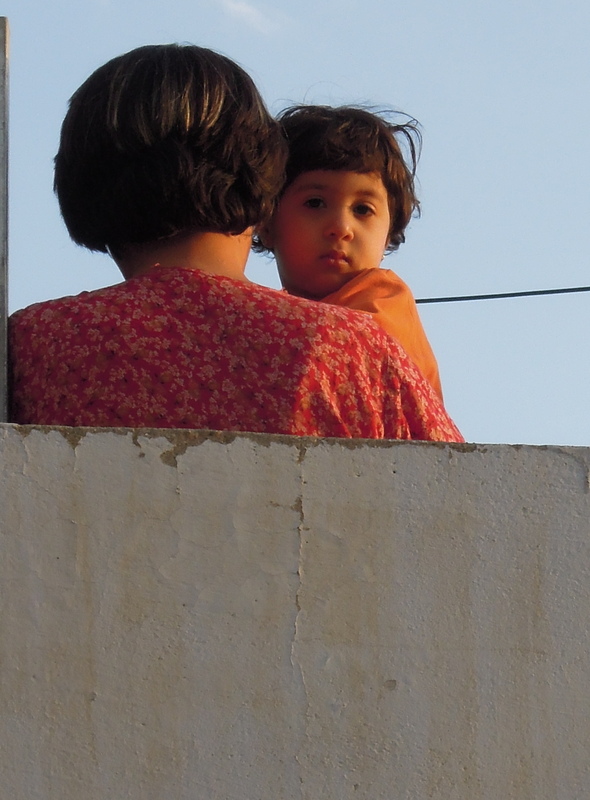
This mother and daughter were standing way up on the roof of their house. The mother did not know I was there and the girl just watched. As I took the photos a man drove up beside me and parked. As he got out of the car he said , "Aw juana?/She is beautiful?". That broke the moment.
These men meet in a vacant lot not far from our house. They find pieces of cardboard to sit on, set up a fine dominoes table and spend hours playing the game. I had observed them several times as I passed, so on one of my last days there this time I stopped to ask if I could take their photo. I fully expected some to say no and then I would not take one. But they were all quite willing. This actually was the third photo, after I had convinced them to continue with their game.


This was the first photo. They arranged themselves. My team mate Pat thinks that they look like a boy band.


Pigeons at the bazaar


This man sells sandwiches- the  typical fast food that is very cheap. Here he has falafel, chicken and chicken livers. His sandwiches were very tasty.

A tailor in his shop at the bazaar. It seems that the men have more public sewing places and they make the men's clothing. The women, like my friend Sharaban, have their sewing rooms at home and sew the women's clothing.

The sunset makes this construction zone look quite beautiful. They are building some sort of building to do with electricity near to our house.

Thursday, May 10, 2012

Berlin: May 1 celebration and Kurds

I left Iraqi Kurdistan at 2:30 am on 30 April and landed in Berlin, Germany the same day. I went to Berlin to be a part of the European CPT Convergence. However, the number of CPTers and interested persons was quite small. Most of the people could not come until Wednesday, so we had a couple of days to roam around Berlin.

Marius van Hoogsraten picked me up at the airport. After I had a nap to make up for the  little sleep I had that night we set off for the celebrations to send off the ghosts of winter and to welcome Spring (or something like that).
Some of the crowd in the park

A remnant of the Berlin Wall in the background.


Huge Bubbles


A jazz group that used these interesting instruments; part autoharp, part sitar and part drum.

Then at 9 pm Pat Thompson, also from the Iraqi Kurdistan team  joined us.


Pat and Marius
 1 May dawned sunny and quite warm. After a nice breakfast we set off on the U Bahns and S Bahns to the area of Berlin known as Kreuzberg. Historically, 1 May has been a day of many riots and much violence. "My Fest" has been created to make the day into one of celebration. The streets of the area are closed to traffic and international food booths are set up by the community members. Various music stages are scattered around the area to provide a place for listening and dancing. The streets were packed with families, younger people and older. It certainly had a festive atmosphere.


In front of the large mosque, Maschari Centre, in Kreuzberg. This was one of the many food stalls to choose from.

The Kreuzberg area of  Berlin has a large Turkish population. I had been told that there were Kurdish people living there too, but that often they are seen as being Turkish. I kept my eyes open. My first clue was a musical group on a stage that sounded very similair to those I had heard for the last 3 months in Iraqi Kurdistan. And, in front of the stage people were doing what looked very much like Kurdish dancing (without the traditional dress).

But, I wondered if the non-Kurdish Turkish people also danced in this way. So I kept my eyes open for a little longer. Soon, I was not unsure anymore. NOTE: these next photos do not have any political statement. They were just what I observed.
For my international readers, this is a poster of a leader of the Kurdish resistance in Turkey. He is currently in prison.
Then I heard some more very familiar music and a huge circle of dancers. Some of them were carrying this flag which is the flag of the resistance fighters, the PKK.
I spied a booth nearby that had another flag that was even  more familiar.

As I stopped to take this photo, the man behind the table directed my gaze way up into the air to many Kurdish flags floating in the breeze.
 At that point I decided to gather my courage to try to speak Kurdish with him. He looked very confused at what I was trying to say. (I like to think that he could not imagine those words of greeting coming from this woman's mouth!!) Once we established that I had just come from Kurdistan the day before he presented me with a CD of Kurdish music. I made sure (with checking 3 times) that he really wanted to give it to me. He pointed me to a man next to him who had moved to Berlin from Sulaimani. But the music was loud and really, my conversation skills are still pretty weak so we then said Khwa Hafees and I went on my way.


The day went on wonderfully. We did have some adventure watching the German riot police (100's of them) as they marched around looking for potential rioting (and I hear that there was some in another part of the city). But we just enjoyed the music, vibe and beer.


A family enjoying the music at one of the stages.

Our evening ended wonderfully as we listened to a gypsy band called "Budzillus" http://www.youtube.com/watch?v=3y5jVpZvlhg. It provided great dance music.


On Wednesday the other CPTer people came and we got down to the real business of the trip. That was really good too!!

Saturday, November 12, 2011

A simple explanation of the bombing and shelling of mountain villages of Kurdistan

(Photo credit: Marcus Armstrong)

(Photo credit: Marcus Armstrong)


Two days after I arrived back in Kurdistan (14 October), we closed up the CPT house in Suleymania and headed north on a public bus to join a 4 person delegation. In Ranya we met our bus driver, Aron and his 14- seater bus. Fortunately, there were only 12 of us together with all of our luggage. It made for some squishy travel arrangements when the rain fell and we could not put the baggage onto the roof. But, as I kept reminding them, at least there were no chickens or goats!

The mountains of the Kurdistan are amazing. They are rugged and many shades of brown. There are not many trees. Some reasons for this have been given, including that Sadaam Hussein chopped many trees down to decrease the hiding places for the Peshmerga, Kurdish resistance fighters. After that Sadaam applied sanctions on the Kurds at the same time as they felt the consequences of the sanction on Sadaam and Iraq by the United Nations.  In order to have fuel, they used  wood from remaining trees. Some reforestation has been implemented, but usually there are few trees to be seen.
A wonderful panoramic shot taken with team mate Lukasz
(credit: Marcus Armstrong)


Our trip took us up to the border regions of Kurdistan. The borders of Iran and Turkey have been the site of a lot of bombing and shelling this year. The reasons are plainly stated, but the history is not so easy and uncomplicated.  We have  been tolds that the Kurds are the largest ethnic population without a country of their own. Before World War I they had been living in areas of this region for centuries (and longer). The subsequent treaties and decisions at the end of that conflict split the Kurdish population into bits. Britain drew lines that created the modern borders of Turkey, Iran, Syria and Iraq right through the Kurdish areas. Out of all of these, the Kurds in Iraq have come out the best. They have been granted the opportunity to have a semi-autonomous government (I understand it as something like our provinces, although that image is probably more wrong, than correct). In the other regions the countries have wanted the Kurds to assimilate and to speak the region's language and to act in the region's way.
The mountains around the village of Suneh where we have accompanied the villagers this Fall
(Photo credit: Patrick  Maxwell (delegate))


This has caused frustration and anger leading to people becoming  resistance fighters- trying to tell the authorities that they don't appreciate being oppressed. These men and women have claimed the mountainous regions as their place of safety and home.  In return  for violence committed by the resistance fighters the leaders have turned to bombing and shelling into the mountainous regions, trying to rout them out and eradicate them.

This is where the villages come into the story.  The mountains have also been the home of small communities of subsistence farmers and nomadic shepherds. Some live in the mountains all summer and fall, then move down to lower latitudes for the snowy months. Others have adequate enough roads and houses that they can hunker down during the cold, preparing for the earliest time they can begin to plow and sow.
We are entering the village of Suneh


The men of Suneh are repairing the corner of the school that was hit by shells this summer. Fortunately, the children were on summer vacation. (credit: Marcus Armstrong)
But, this is when the shelling and bombing begins. As soon as the snow clears and people are on the fields, the planes begin to fly over (from Turkey) and the heavy artillery is pointed their way (from Iran). The vllagers don't know when a rocket or bomb will come close enough to hurt them so they escape from their villages down to the valleys. However, during the time they are away their houses are damaged by the rockets, their crops wither due to lack of frequent irrigation and their opportunity to earn a livelihood disappears. Also, they are forced into tent camps by the side of roads and rivers with minimal provision for their basic needs. In recent days some villages have been directed by the government  to return to their homes from the tent IDP camps. Government workers have forcibly removed all aid such as water tanks and generators. However, other villages are still being heavily bombed so they  are scrambling to create winter-secure tent dwellings as I write this.
Internally Displaced Persons (IDP) tent camp where the families of Suneh spent the end of summer and the Fall.


In my next blog I want to tell a couple of stories of people that we met from these villages.